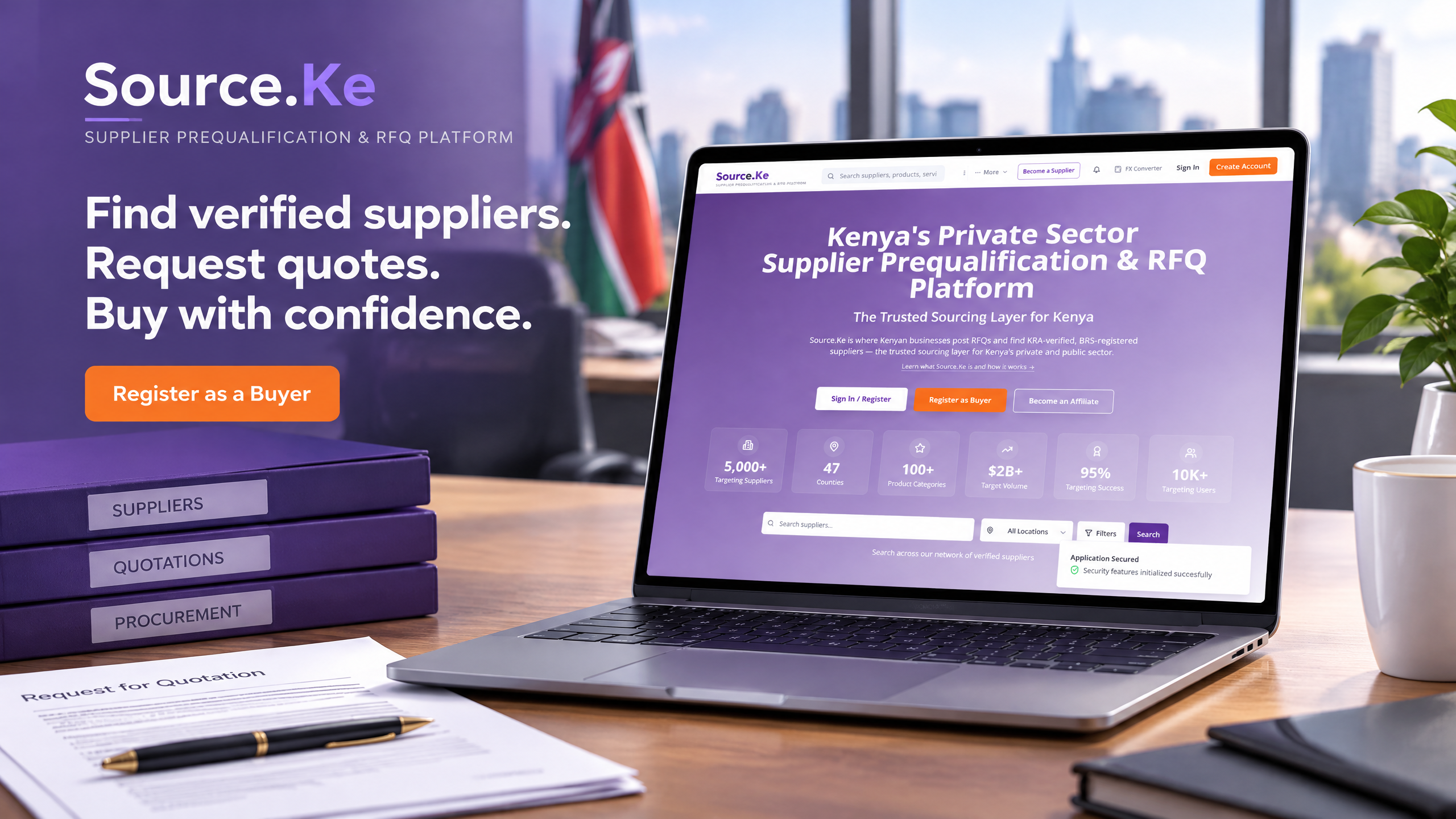

Supplier onboarding in Kenya is the process of getting your business registered, documented and visible to buyers so you can start receiving orders and RFQs. Done well, it takes a few days. Done badly, it can cost you tenders and contracts. This guide compares six platforms and channels where Kenyan suppliers can onboard in 2026, and which one fits which kind of business.
Disclosure: Tenderzville operates Source.ke, which appears in this list. We explain where it fits and where another channel is a better first step.
Before You Onboard Anywhere: Your Document Pack
Almost every buyer and platform asks for the same core documents. Get these ready first and every onboarding will take half the time:
- Certificate of Incorporation or business registration
- KRA PIN certificate
- Valid Tax Compliance Certificate (TCC): valid for 12 months, and KRA now links it to eTIMS/TIMS compliance
- CR12 or beneficial ownership details
- Insurance and quality certificates where relevant (ISO, KEBS)
- Bank details and a physical office address
Expired or mismatched documents are among the most common reasons suppliers are knocked out. See our guide to why suppliers fail pre-qualification.
1. eGP Kenya: Best First Step for Government Supply
Since 1 July 2026, the official eGP portal at egpkenya.go.ke is mandatory for public procurement. If you want to supply a ministry, county or state corporation, registration here comes first.
Strengths: It is the official route and nothing replaces it for government work.
Weaknesses: It serves public tenders only. Registering does not make private buyers aware of you. Our eGP registration guide walks through the steps.
2. Source.ke: Best Onboarding for Private-Sector Buyers
Source.ke is built so a supplier can go from sign-up to a public, searchable profile quickly, and then keep that profile useful over time. It earns second place because government registration is mandatory for public work, but for private-sector business it is the more direct route.
How onboarding works:
- Create an account with email, a password of at least six characters and acceptance of the terms, or continue with Google.
- Pick your role. Supplier, Buyer, Lender, Transporter, Warehouse Provider, SCM Professional, Dispute Consultant or Affiliate, with the option to switch later in settings.
- Complete your profile. Onboarding percentage gates public listing, so the profile has to reach a minimum level of completeness before it goes live.
- Add your KRA PIN. A KRA PIN check is mandatory before a supplier listing goes public. A Tax Compliance Certificate is optional but unlocks premium features.
- Work through the compliance checklist. Tier 1: business registration, KRA PIN, TCC and CR12/BOI. Tier 2: insurance and quality/standards. Tier 3: category-specific test reports.
- Disclose a physical office. This is required and shown in trust reviews.
- Set payment terms and Incoterms. Credit, bank, crypto, cash or cheque, plus terms like FCA, CPT or CIP.
- Download your Trust Passport. A QR identity card, in PNG or PDF, that you can put on invoices, delivery trucks and shop counters. Buyers scan it to open your public page.
After listing, your dashboard shows Open RFQs, Live Auctions, Prequalification, Buyer References, Rewards Center and Payouts. Your Data Freshness Score, out of 100, feeds search ranking, trust score and RFQ matches, and the target is 80 or above. You cannot boost it manually; it reflects your actual data.
Limitations: It is a marketplace, not a regulator, so it does not replace eGP for government tenders. You must keep documents current, and memberships such as KAM, KEPSA, KNCCI and AGPO are self-declared.
Cost: Free, Standard and Featured plans. Featured is KSh 10,000 for a full year.
3. Buyer-Specific Supplier Portals: Best for Winning One Large Customer
Many large corporates, banks and NGOs run their own supplier registration portals. If one customer represents a big share of your potential revenue, onboarding there is worthwhile.
Strengths: Direct access to a named buyer.
Weaknesses: Each portal has different forms and document requirements, and registering rarely creates visibility with anyone else.
4. KNCCI and Industry Associations: Best for Credibility and Networking
Membership in the Kenya National Chamber of Commerce and Industry, the Kenya Association of Manufacturers or the Kenya Private Sector Alliance adds credibility and access to events and introductions.
Strengths: Relationships and referrals.
Weaknesses: Membership does not generate orders by itself and there is a fee. Many buyers treat it as a supporting signal, not a primary one.
5. Social Media Business Pages: Best for Visibility and Retail Leads
A Facebook page, WhatsApp Business catalogue and LinkedIn profile put you in front of buyers searching informally.
Strengths: Free and fast.
Weaknesses: Larger buyers rarely award contracts from social profiles because there are no documents to review. Use it to support, not replace, formal onboarding.
6. Your Own Website and Google Business Profile: Best for Long-Term Discoverability
A simple website and a Google Business Profile help buyers find you when they search for your product and location.
Strengths: You control the message and it builds over time.
Weaknesses: It takes time to rank, and it does not include compliance documents buyers want to see.
Comparison Table
| Channel | Best for | Documents required | Cost | Time to go live |
|---|---|---|---|---|
| eGP | Government supply | Full set | Registration | Days |
| Source.ke | Private-sector RFQs and discovery | Checklist in tiers | Free plan available | Same day once profile is complete |
| Buyer portals | One large customer | Buyer-specific | Free | Varies |
| KNCCI / associations | Credibility | Membership forms | Membership fee | Days |
| Social media | Retail leads | None | Free | Hours |
| Own website | Long-term search traffic | None | Hosting | Weeks |
A Practical Onboarding Plan for the First 30 Days
- Week 1: assemble documents. Renew your Tax Compliance Certificate if it is within a month of expiry and confirm your registration details match everywhere.
- Week 2: register on eGP if you want public business, and complete your Source.ke profile for private buyers.
- Week 3: finish the compliance checklist and add insurance and quality certificates to lift your profile score.
- Week 4: start responding. Reply quickly to RFQs, add buyer references as deals close and keep your data current.
Common Onboarding Mistakes
- Names that do not match. The business name on your KRA PIN, registration and bank account should be identical.
- An expired Tax Compliance Certificate. Renew before expiry, not after.
- A half-finished profile. Incomplete profiles rank lower and never reach public listing on some platforms.
- Ignoring your dashboard. RFQs have deadlines. Slow responses lose business.
- No physical address. Buyers treat virtual-only suppliers with caution.
How to Keep Your Profile Working After Onboarding
Getting listed is the start, not the finish. Buyers choose suppliers who look active and current.
- Refresh documents before they expire. Set reminders for your Tax Compliance Certificate and insurance renewal dates.
- Keep your product list accurate. Remove items you no longer stock and add new lines as they arrive.
- Respond to RFQs quickly. A fast, complete reply beats a slow, perfect one.
- Collect references. After each successful order, ask the buyer to confirm the delivery so your record grows.
- Use your Trust Passport. Put the QR identity card on invoices and vehicles so buyers can find your public page in seconds.
- Review your numbers monthly. Look at which RFQs you won, which you missed and why.
Frequently Asked Questions
How long does supplier registration take in Kenya?
If your documents are ready, most platform profiles can be completed in a day. Government registration timelines vary, so start early.
Do I need both eGP and Source.ke?
If you want government and private business, yes. They serve different buyers.
Is it free to register on Source.ke?
Source.ke has a free plan, plus Standard and Featured plans for more visibility. Featured is KSh 10,000 for a full year.
What documents do I need to onboard as a supplier?
At minimum: business registration, KRA PIN, a valid Tax Compliance Certificate and CR12 or beneficial ownership details.
The Bottom Line
Treat onboarding as two tracks. Register on eGP for government supply, and build a complete Source.ke profile for private-sector RFQs and discovery. Keep your documents current and your profile score high, and use associations and social channels to reinforce, not replace, the formal route.
Ready to get listed? Create your Source.ke account.
Want more Kenyan procurement guides in your Google results? Add Tenderzville as a preferred source: