
To find youth, women and PWD-owned suppliers in Kenya, start with a platform that lets you filter by ownership group, then check each supplier’s documents yourself. It is no longer a side project for procurement teams: under the Public Procurement and Asset Disposal Act, public entities must reserve 30% of their tenders for youth, women and persons with disabilities, and a growing number of private buyers now set the same kind of targets in their own supplier policies. The problem is practical: where do you actually go to find these businesses, and how do you know they are ready to supply you? Below are seven places to look, ranked on the same criteria.

Disclosure: Tenderzville operates Source.ke, which appears in this list. We ranked every option on the same criteria below and tell you where each one falls short.
How we ranked these ways to find youth, women and PWD-owned suppliers in Kenya
We scored each option on five questions a buyer actually cares about:
- Can you filter by ownership group? Youth, women and persons with disabilities.
- Does it cover private-sector buying, or only government?
- How current is the supplier data?
- Can you request a quotation without leaving the platform?
- What does it cost to use?
1. Source.ke: Best for Filtering Inclusive Suppliers in the Private Sector
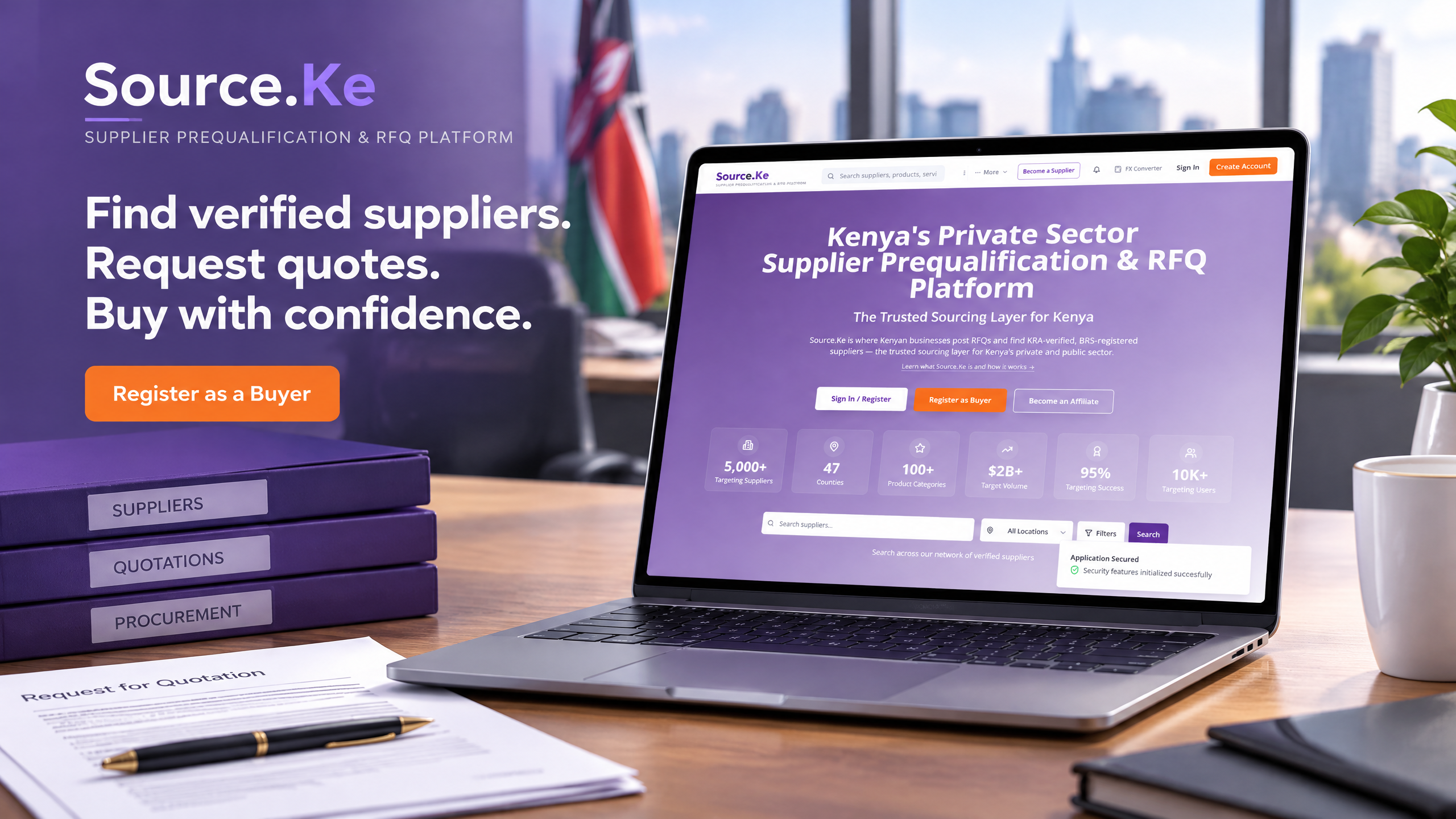
Source.ke is the only platform on this list built around private-sector prequalification and RFQs that also lets buyers find youth, women and PWD-owned suppliers in Kenya through a deliberate ownership filter. That is the reason it sits at number one for this specific job.
What makes it useful for inclusive sourcing:
- Ownership filters. Buyers can narrow search to youth-owned, women-owned or PWD-owned suppliers instead of reading each profile.
- Compliance checklist. Suppliers upload a Certificate of Incorporation or business registration, KRA PIN, Tax Compliance Certificate and CR12/BOI as Tier 1 items, with insurance and ISO/KEBS standards as Tier 2.
- Data Freshness Score. Each profile carries a score out of 100 that feeds search ranking and RFQ matching and cannot be boosted by hand.
- Payment terms on the profile. Credit, bank, crypto, cash or cheque, so buyers know what they are agreeing to before contact.
- Built-in RFQs. Send a request to matched suppliers from the same dashboard.
- Trust Passport. A downloadable QR identity card suppliers can put on invoices, delivery trucks and shop counters.
Where it falls short: Source.ke is a marketplace, not a regulator. Trade association memberships such as KAM, KEPSA, KNCCI and AGPO are self-declared by the supplier, so a buyer should still ask for the AGPO certificate itself. It is also newer than the government channels below, so supplier numbers in some categories are still growing.
Cost: Free, Standard and Featured plans. Featured is KSh 10,000 for a full year.
2. The AGPO Registration Records on the eGP Portal: Best for Public-Sector Compliance
If you are a government buyer, this is where you start to find youth, women and PWD-owned suppliers in Kenya for reserved tenders. The AGPO (Access to Government Procurement Opportunities) registration is the legal basis for the 30% reservation. Since eGP became mandatory on 1 July 2026, supplier registration, including AGPO status, runs through the official portal at egpkenya.go.ke, and suppliers get their AGPO certificate through agpo.go.ke.
Strengths: It is the authoritative record for reserved tenders. If a tender is reserved under AGPO, this is the status evaluators will look at.
Weaknesses: It is a registration system, not a discovery tool. It will not help you compare capacity, payment terms or product range, and it does not serve private buyers who want inclusive sourcing outside the Act. For discovery, you will usually pair it with a marketplace.
See our step-by-step guide: How to Register for AGPO in Kenya.
What the data says about AGPO suppliers. We analysed about 30,500 published AGPO awards. Most winners sold to only one buyer, and typical awards are small, so a supplier with an AGPO certificate is not automatically a supplier with a track record. Read the full analysis of AGPO contracts in Kenya before you shortlist, and ask each supplier who else they currently supply.
3. KNCCI Chapters: Best for Local Small-Business Networks
The Kenya National Chamber of Commerce and Industry has chapters in most counties, and many youth and women entrepreneurs are members. Chapter offices and events are a good way to find youth, women and PWD-owned suppliers in Kenya in person, especially outside Nairobi.
Strengths: Local reach, relationships and referrals.
Weaknesses: There is no standard searchable supplier database with ownership filters, and membership does not mean compliance documents are on file. Expect to do your own paperwork checks.
4. Industry Associations (KAM, KEPSA): Best for Established Manufacturers
The Kenya Association of Manufacturers and the Kenya Private Sector Alliance run member directories and sector working groups. If you need volume manufacturers, these are credible starting points.
Strengths: Established members and policy influence.
Weaknesses: Membership skews toward larger firms, so youth- and women-owned micro and small enterprises are less visible. Neither association filters by ownership group.
5. Government Enterprise Programmes: Best for Early-Stage Businesses
Youth and women enterprise funds, and the National Council for Persons with Disabilities, run training and registration support for owners in their target groups. They are a good source of leads for very small suppliers who are still formalising.
Strengths: They reach owners no marketplace has reached yet.
Weaknesses: You will be dealing with businesses at the start of their compliance journey. Plan time for them to get a KRA PIN, Tax Compliance Certificate and registration documents in order before you award anything.
6. Social Media and WhatsApp Groups: Best for Quick Leads
Facebook groups, WhatsApp communities and LinkedIn are where many small suppliers advertise, so they are a quick way to find youth, women and PWD-owned suppliers in Kenya who are not on any directory yet. They are fast and free.
Strengths: Instant reach and real conversations.
Weaknesses: No documents, no ownership confirmation, and no recourse if a supplier disappears after a deposit. Treat these as leads, not as suppliers.
7. Your Own Referral List: Best for Low-Risk Repeat Buying
Colleagues and past suppliers know who delivers. A referral costs nothing and has context no directory has.
Weaknesses: It does not scale and it keeps you inside the same circle. If your goal is to widen your supplier base, a searchable platform has to complement it.
Comparison: Seven Ways to Find Youth, Women and PWD-Owned Suppliers in Kenya
| Option | Ownership filter | Private sector | Built-in RFQ | Best for |
|---|---|---|---|---|
| Source.ke | Yes (youth, women, PWD) | Yes | Yes | Inclusive sourcing at scale |
| eGP / AGPO records | Registration status | No | Tender-based | Public reserved tenders |
| KNCCI chapters | No | Yes | No | Local networks |
| KAM / KEPSA | No | Yes | No | Established manufacturers |
| Enterprise programmes | By programme | Limited | No | Early-stage suppliers |
| Social media groups | No | Yes | No | Quick leads |
| Referrals | No | Yes | No | Repeat buying |
How to Find Youth, Women and PWD-Owned Suppliers in Kenya Without Taking on Extra Risk
Inclusive sourcing works best when it is a process, not a gesture. A simple routine many buyers use to find youth, women and PWD-owned suppliers in Kenya and keep risk low:
- Define the target. For example, 30% of annual spend with youth, women or PWD-owned suppliers.
- Search where you can filter. Use a platform with ownership filters to build a shortlist of five to ten suppliers.
- Ask for the paperwork. KRA PIN, Tax Compliance Certificate, business registration and, where relevant, the AGPO certificate.
- Send the same RFQ to all of them. Equal specifications make price and lead time comparisons fair.
- Start with a small order. Use it to learn delivery performance before scaling.
- Record outcomes. Feed delivery and quality results back into your supplier list.
Common Mistakes When Sourcing From Youth, Women and PWD-Owned Businesses
- Treating it as a quota, not a relationship. Suppliers who get one small order and never hear back rarely grow. Give feedback and repeat business to the ones that perform.
- Setting terms only large firms can meet. Very short payment terms, heavy tender security or huge minimum volumes shut out the smaller suppliers you are trying to reach. Where you can, split large orders into lots.
- Assuming a label means compliance. Ownership is one attribute. Delivery, quality and paperwork still need checking.
- Forgetting payment discipline. Small suppliers have little cash buffer, so paying on time is the most practical support a buyer can give.
- Not measuring. Track the share of spend and the number of suppliers in each group, every quarter, and report it.
Used well, inclusive sourcing widens your supplier base, reduces dependence on a handful of vendors and can improve local resilience, which is a business argument as well as a social one.
Frequently Asked Questions
How do I find youth, women and PWD-owned suppliers in Kenya?
Use a platform with ownership filters, such as Source.ke, for private-sector buying, and use the eGP and AGPO records for reserved public tenders. Then ask every supplier for their KRA PIN, Tax Compliance Certificate and registration documents before you award anything.
What is the AGPO 30% rule in Kenya?
Public entities must set aside 30% of their procurement opportunities for registered youth, women and persons-with-disabilities-owned businesses. Suppliers need AGPO registration to qualify for these reserved tenders.
Can private companies source from youth, women and PWD-owned suppliers?
Yes. The 30% rule binds public entities, but private buyers can set their own targets. A platform with ownership filters, such as Source.ke, makes it practical to find qualified suppliers quickly.
Do I still need to check a supplier’s documents?
Always. Any marketplace is a place to find suppliers, not a guarantee. Ask for a KRA PIN, Tax Compliance Certificate and registration documents, and run your own due diligence before awarding a contract.
Is it free to find suppliers on Source.ke?
Source.ke has Free, Standard and Featured plans. See the platform for what each plan includes.
The Bottom Line
If you need a searchable, filterable way to find youth, women and PWD-owned suppliers in Kenya for private-sector buying, Source.ke is the most direct option. If you are a public entity running reserved tenders, work through the eGP and AGPO records. Most buyers will use both, and add referrals and local networks for depth.
Ready to find youth, women and PWD-owned suppliers in Kenya and build your shortlist? Create a free account on Source.ke and filter by ownership group.
Want more Kenyan procurement guides in your Google results? Add Tenderzville as a preferred source: