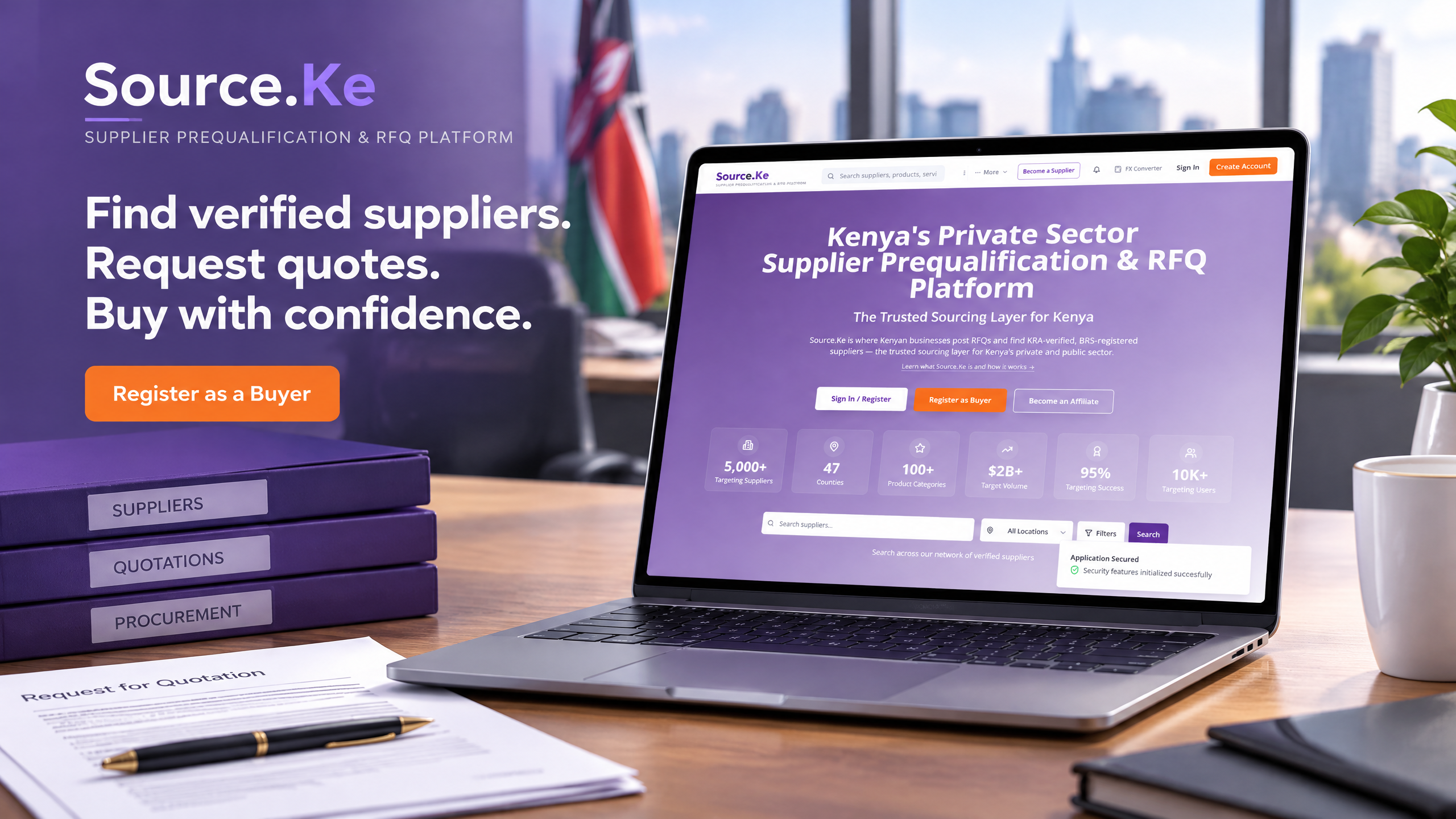

How to avoid bad suppliers in Kenya comes down to checking the right records before you pay. Every procurement officer has a story: the deposit that vanished, the “factory” that was a rented desk, the delivery that arrived short and late. This guide ranks seven tools and checks Kenyan buyers can use in 2026 to catch problems before they cost money.
Disclosure: Tenderzville operates Source.ke, which appears in this list. We explain where it helps and where you still need to do your own checking.
Why Supplier Due Diligence Matters More in 2026
Kenya’s tax authority now ties Tax Compliance Certificates to eTIMS/TIMS compliance, eGP is mandatory for public business, and buyers are under pressure to show an audit trail. A supplier who cannot produce clean paperwork is a risk, even if their price is attractive. The seven checks below work best together.
1. KRA iTax and the TCC Checker: Best for Tax Compliance
A valid Tax Compliance Certificate shows a supplier has filed required returns and has no outstanding tax liabilities. It is valid for 12 months from the date of issue. The KRA iTax portal at itax.kra.go.ke lets you confirm a certificate with the online certificate checker rather than trusting a PDF.
Strengths: It is the authoritative source and it is free.
Weaknesses: It tells you about tax compliance only. A supplier can be tax-compliant and still deliver poor quality or late.
2. Business Registration Service (BRS) Company Search: Best for Ownership and Registration
A company search through the Business Registration Service on eCitizen shows whether the business exists, its registered name, and its directors and shareholders on file. A CR12 gives you the ownership picture on paper.
Strengths: It confirms the legal entity behind the trade name.
Weaknesses: It does not tell you anything about delivery history. A well-registered company can still be a poor supplier.
3. Source.ke Trust Center and Supplier Profile Checks: Best for Conduct and Delivery Context
Source.ke earns a high place here because it combines document checks with a way to see conduct signals, something the two government tools above do not provide. We rank it third, after the two official records, because those are the legal source of truth for tax and registration.
What buyers get:
- KRA PIN check before a listing goes public. A supplier listing cannot go public without it. The Tax Compliance Certificate check is optional but unlocks premium features.
- Compliance checklist. Business registration, KRA PIN, TCC and CR12/BOI as Tier 1; insurance and ISO/KEBS standards as Tier 2; category-specific test reports as Tier 3.
- Physical office disclosure. Suppliers must disclose a physical office, and a virtual-only presence is not treated as a trust badge.
- Home Office Privacy Requests. Home-office addresses are not public. Buyers request access for due diligence and the supplier approves or declines each request.
- Site visits. A buyer can request a visit as part of due diligence, for a flat KSh 500 intake fee, with scheduling subject to admin review.
- Buyer references and reviews. Supplier ratings come from reviews only.
- Alleged Policy Violators page. A published list of unresolved conduct reports, with safeguards: only a counterparty with a real transaction may file; dispute resolution must have been tried first; evidence is checked before publication; the listed party gets a 14-day, unedited right of reply; and entries expire after 18 months. These are reports, not court findings and not accusations by Source.ke.
Limitations: Source.ke is a marketplace. Trade association memberships (KAM, KEPSA, KNCCI, AGPO) are self-declared and not checked by the platform, and buyers remain responsible for their own due diligence. A site visit is a service you request, not an automatic part of every listing.
4. eGP Supplier Records: Best for Public-Sector Eligibility
For anyone selling to government, the official portal at egpkenya.go.ke is the system of record. A supplier registered and active there has completed the government’s own registration process.
Weaknesses: It is a registration record. It does not rate performance or surface complaints from private buyers.
5. KEBS and Standards Checks: Best for Product Quality Claims
If a supplier claims a KEBS Standardization Mark or ISO certification, ask for the certificate number and confirm it with the issuing body. This matters most for food, cosmetics, electrical goods and building materials.
Strengths: It directly tests a quality claim.
Weaknesses: It covers products, not business conduct, and the process can be slow.
6. Trade References and Past Buyers: Best for Real Performance
Ask for two or three recent buyers and call them. Ask about on-time delivery, short deliveries, disputes and how the supplier behaves when something goes wrong.
Strengths: Nothing beats hearing from someone who has paid the supplier.
Weaknesses: A supplier will only give friendly references. Treat them as a minimum, not proof.
7. A Physical Visit: Best Final Check Before a Large Order
For any significant order, visit the premises. Look for stock, machinery, staff and a working office that matches the address on the documents.
Strengths: It is hard to fake a functioning operation.
Weaknesses: It takes time and travel. For distant suppliers, a requested site visit through a platform can substitute.
Comparison Table
| Check | What it confirms | What it misses | Cost |
|---|---|---|---|
| KRA iTax / TCC checker | Tax compliance | Delivery quality | Free |
| BRS company search | Legal entity and owners | Performance | Small fee |
| Source.ke Trust Center | Documents, office disclosure, conduct reports, reviews | Self-declared memberships | Free to browse; site visit KSh 500 |
| eGP records | Public-sector registration | Private-buyer experience | Free |
| KEBS / ISO | Product standards | Business conduct | Varies |
| References | Real delivery history | Unfriendly experiences | Your time |
| Physical visit | Operation exists | Long-run reliability | Travel |
Red Flags to Walk Away From
- Pressure to pay a deposit to a personal number instead of a company account.
- A Tax Compliance Certificate that is expired or cannot be confirmed on iTax.
- No physical address or an address that does not match the registration documents.
- Prices far below the market with no explanation.
- Reluctance to supply references or to host a visit.
- Documents with inconsistent names across the KRA PIN, registration and bank account.
A Simple Five-Step Supplier Check
- Confirm the TCC on KRA iTax.
- Run a company search and read the CR12.
- Review the supplier’s profile and documents on a platform such as Source.ke.
- Call two past buyers.
- For orders above your own risk threshold, visit in person or request a site visit.
What to Do If You Have Already Paid a Bad Supplier
If a transaction has already gone wrong, act quickly and keep records.
- Stop further payments. Do not send more money to recover what is already lost.
- Gather evidence. Contracts, invoices, receipts, M-Pesa and bank statements, emails and chat messages.
- Put your complaint in writing. State what was agreed, what happened and what you want, with a deadline.
- Try to resolve it. Many disputes are settled at this stage, and a documented attempt is useful if you escalate.
- Escalate where appropriate. That may mean a demand letter, mediation, a report to the police or a civil claim, depending on the amount and the facts. Take legal advice for significant sums.
- Tell the platform. If you met the supplier through a marketplace, report it so other buyers can be protected.
Prevention is cheaper than recovery. A few minutes of checking before the first payment is almost always worth it.
Frequently Asked Questions
How do I check if a Kenyan supplier is legitimate?
Confirm their Tax Compliance Certificate on KRA iTax, run a business registration search, review their documents and references, and for larger orders visit the premises.
What is a CR12 and why does it matter?
A CR12 is an official company search document listing directors and shareholders. It shows who is behind the business.
What should I do if a supplier scams me?
Keep all records, try to resolve the dispute in writing, and report to the relevant authorities. On Source.ke, a counterparty with a real transaction can file a conduct report after dispute resolution has been tried.
Does Source.ke guarantee its suppliers?
No. Source.ke is a marketplace. It gives you documents, profile data, reviews and conduct reports to inform your decision, but you remain responsible for your own due diligence.
The Bottom Line
Use the official records for tax and registration, use a platform for profile data, conduct signals and documents in one place, and use references and visits for the final call. No single check is enough, and the combination is what keeps your money safe.
Want to review suppliers before you pay? Browse Source.ke.
Want more Kenyan procurement guides in your Google results? Add Tenderzville as a preferred source: