
Finding transporters and warehouse providers in Kenya is a daily headache for importers, exporters, manufacturers and online sellers. A missed truck or a full warehouse can stall a whole supply chain. This guide compares seven channels for sourcing logistics and storage partners in 2026, from specialist marketplaces to industry bodies, with honest strengths and weaknesses for each.
Disclosure: Tenderzville operates Source.ke, which appears in this list. We explain where it helps and where other channels are stronger.
What Buyers Need From a Logistics Sourcing Channel
- Range: trucks, bikes, cold chain, bonded and general warehousing.
- Clear terms: price basis, payment terms and liability.
- Company checks: registration, tax compliance and insurance.
- Speed: how quickly you get quotations.
- Cost to search: time and money.
Cold chain, e-commerce and cross-border trade are all growing in Kenya, which means demand for reliable partners is rising too. Fuller sourcing context is in our B2B sourcing guide.
1. Industry Contacts and Referrals: Best for Trusted Repeat Partners
Ask other shippers who they use. A referral from a business with a similar cargo profile is hard to beat.
Strengths: Real experience and no search cost.
Weaknesses: It keeps you inside one circle and does not give you competing quotes.
2. Source.ke: Best for Comparing Transporters and Warehouse Providers Alongside Suppliers
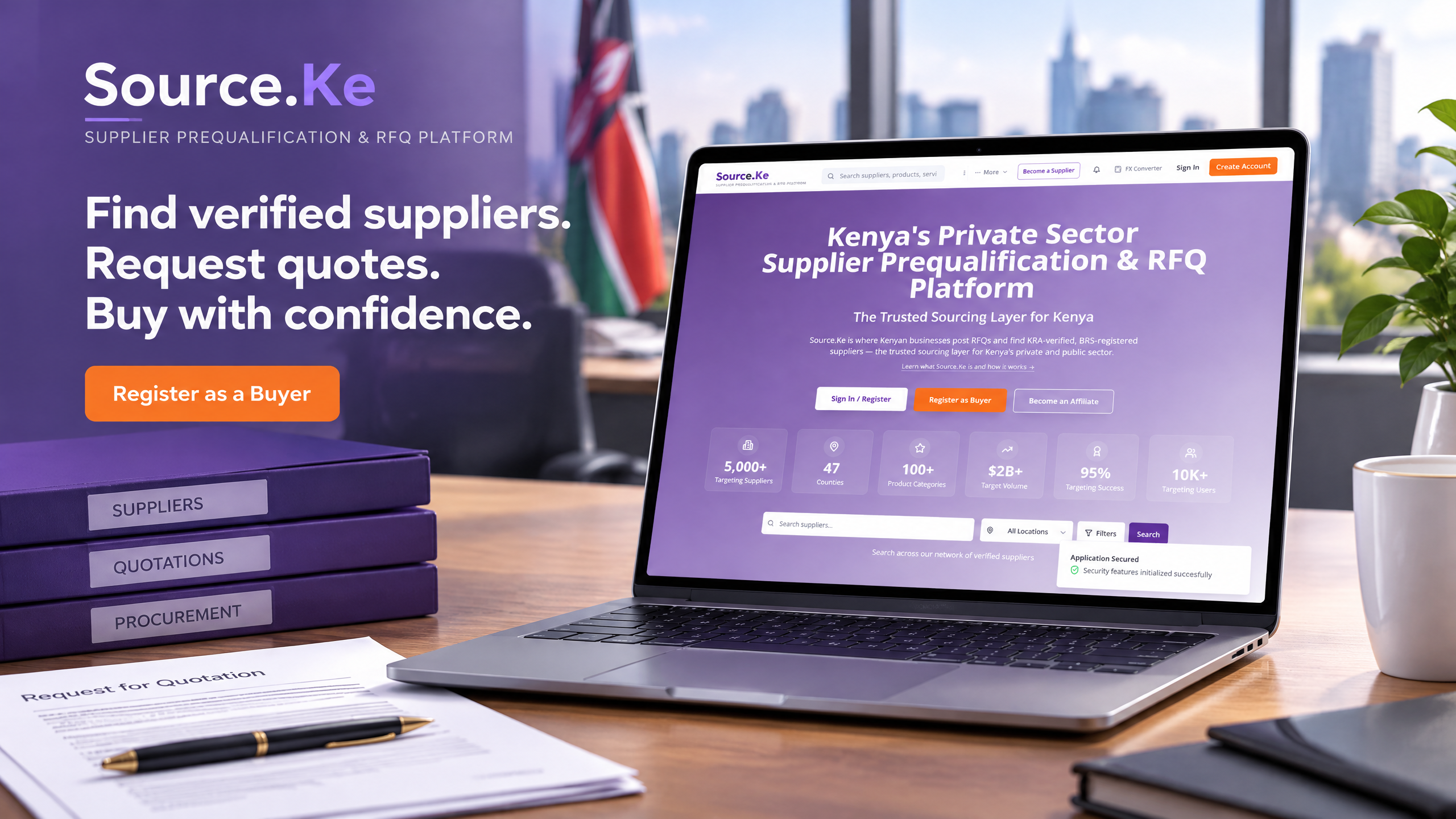
Source.ke lets Transporters and Warehouse Providers register as dedicated roles, so a buyer can look for logistics partners in the same place they look for goods. It sits second because referrals remain the most trusted source, but it is the strongest option for building a broader, comparable list.
Why it helps logistics buyers:
- Dedicated roles. Transporters and warehouse providers have their own sign-up path and dashboard card, rather than being squeezed into a goods-only listing.
- Compliance checklist. Business registration, KRA PIN, Tax Compliance Certificate and CR12/BOI as the core, with insurance as a recommended Tier 2 document. For a transporter, an insurance certificate on file is exactly what you want to see.
- Physical office disclosure. Required and shown in trust reviews.
- Payment terms and Incoterms visible on profiles, which suits cross-border work.
- Reviews and buyer references to inform your decision.
- Trust Center conduct reports. Counterparty-filed, evidence-checked and subject to a 14-day right of reply.
- RFQs. Ask several providers for a quotation at once.
Limitations: Source.ke is a marketplace only and is not liable for logistics outcomes. Coverage by region and by specialist type, such as refrigerated transport, depends on who has registered, so you may need to widen your search.
Find transporters and warehouse providers on Source.ke
3. Industry Associations: Best for Established Operators
Freight and transport associations, the Kenya Association of Manufacturers and the Kenya Private Sector Alliance run networks that include logistics members.
Strengths: Established operators and sector information.
Weaknesses: Membership lists are not always searchable by service type, and membership does not guarantee service quality.
4. Industrial Park and SEZ Operators: Best for Large Warehousing Needs
Special economic zones and industrial parks such as Tatu City advertise warehouse and industrial space directly to larger tenants.
Strengths: Modern facilities and on-site services.
Weaknesses: They tend to target larger, longer leases, which is not ideal for a small business needing a few pallets for a season.
5. Freight Forwarders and 3PLs: Best for End-to-End Management
If you do not want to manage trucks and storage separately, a third-party logistics provider or freight forwarder bundles transport, warehousing and customs for you.
Strengths: One contract and one point of contact.
Weaknesses: You pay a margin for the convenience and you depend on one provider’s network. Compare at least two quotes.
6. Online Search and Maps: Best for Local Options
Searching for warehouses or transporters near a given town can surface small local operators you would not otherwise find.
Strengths: Wide coverage.
Weaknesses: Listings are self-reported and uneven. Treat each result as a lead to check.
7. Social Media and WhatsApp Groups: Best for Spot Capacity
Transport groups are where spare truck capacity and last-minute loads are traded.
Strengths: Speed.
Weaknesses: No documents and little recourse if cargo goes missing. Use it for low-value or low-risk loads only, and insist on written terms.
Comparison Table
| Channel | Best for | Company documents | Multiple quotes | Main risk |
|---|---|---|---|---|
| Referrals | Trusted repeat partners | Your own checks | No | Narrow choice |
| Source.ke | Comparing providers in one place | Checklist and profile | Yes (RFQ) | Coverage varies by region |
| Associations | Established operators | Varies | No | Not searchable by service |
| Industrial parks / SEZs | Large leases | Lease process | Limited | Minimum size |
| Freight forwarders / 3PLs | End-to-end | Contract | Yes | Margin and dependence |
| Online search | Local options | None | Manual | Unchecked claims |
| Social media groups | Spot capacity | None | Informal | No recourse |
What to Check Before You Sign With a Transporter or Warehouse
For transporters
- Insurance: goods-in-transit cover and its limits.
- Vehicle documents: logbooks, inspection and licences.
- Tracking: can you see where your cargo is?
- Liability terms: what happens if goods are damaged or delayed.
For warehouse providers
- Physical inspection: security, fire safety, pest control and racking.
- Stock records: how they log receipts and dispatches.
- Insurance: who insures stock, and for how much.
- Special needs: temperature control, bonded storage or hazardous goods approvals.
For both
- KRA PIN and Tax Compliance Certificate.
- Business registration and CR12.
- Two recent client references.
How to Run a Quick Logistics RFQ
- Define the job. Origin, destination, cargo type, weight or volume, dates and any handling needs.
- Specify storage needs. Pallets or square metres, temperature range, duration and access hours.
- Send the same brief to three to five providers.
- Compare like for like. Price, lead time, insurance, liability and payment terms.
- Trial first. Start with a single load or a short storage period.
Special Cases: Cold Chain, E-Commerce and Cross-Border Cargo
Cold chain
Perishable goods need refrigerated transport and temperature-controlled storage. Ask providers how they monitor temperature, what happens if a unit fails and how they document the temperature log. A lower price is not a bargain if the cargo spoils.
E-commerce and last-mile
Online sellers need fast, predictable delivery and a clean returns process. Check coverage areas, cash-on-delivery handling and how the provider reports failed deliveries.
Cross-border
For goods moving through Mombasa or across the EAC, confirm who handles customs documents and what happens at border delays. Agree the Incoterm in writing so both sides know who pays for what and when risk transfers.
Contract Terms Worth Agreeing in Writing
Even a simple transport or storage arrangement should be written down. At minimum, agree:
- Scope and price. What is included, what is extra and how charges are calculated.
- Payment terms. Deposit, balance and due dates, plus how payment is made.
- Liability and insurance. Who is responsible for loss or damage, up to what value, and who holds the policy.
- Service levels. Pick-up and delivery times, and what happens if they are missed.
- Handling instructions. Temperature ranges, stacking limits, hazardous goods rules.
- Termination. How either side can end the arrangement and with how much notice.
A written agreement also protects the provider. Good operators welcome clear terms because they reduce arguments and make it easier to price accurately.
Frequently Asked Questions
How do I find a reliable transporter in Kenya?
Combine referrals with a platform that lets you compare providers and see their documents, then check insurance and references before committing.
Can I find warehouse space on Source.ke?
Yes. Warehouse Providers can register as their own role on Source.ke, and buyers can search and send requests. Availability depends on who has listed in your area.
Does Source.ke handle my shipment?
No. Source.ke is a marketplace and is not liable for logistics. You contract directly with the provider.
What insurance should a transporter have?
At least goods-in-transit cover that matches the value of your cargo. Ask to see the certificate and the cover limit.
The Bottom Line
Start with referrals, then widen your list through a platform where transporters and warehouse providers have documents, reviews and payment terms on their profiles. Source.ke is a strong place to build that comparison list, and you should still inspect, ask for references and start small.
Need quotes from several providers? Post your request on Source.ke.
Want more Kenyan procurement guides in your Google results? Add Tenderzville as a preferred source: