
AGPO contracts in Kenya are mostly small, quick quotation awards, and the suppliers who win them rarely keep winning from the same buyer year after year. That is what we found after analysing about 30,500 AGPO-flagged awards published on the government’s PPIP contracts page between the 2023/24 financial year and 13 October 2026. This is an ongoing analysis, and we will update it as more awards are published.
Last updated: 1 November 2026. 2025/26 and 2026/27 are still filling in, so only 2023/24 and 2024/25 are complete years.
AGPO contracts in Kenya at a glance (2023/24 to 2026/27)
| Measure | 2023/24 | 2024/25 | 2025/26 (partial) | 2026/27 (early) |
|---|---|---|---|---|
| AGPO-flagged awards published | 11,834 | 13,783 | 4,652 | 251 |
| Share of all published contracts (number) | 34% | 35% | 39% | 45% |
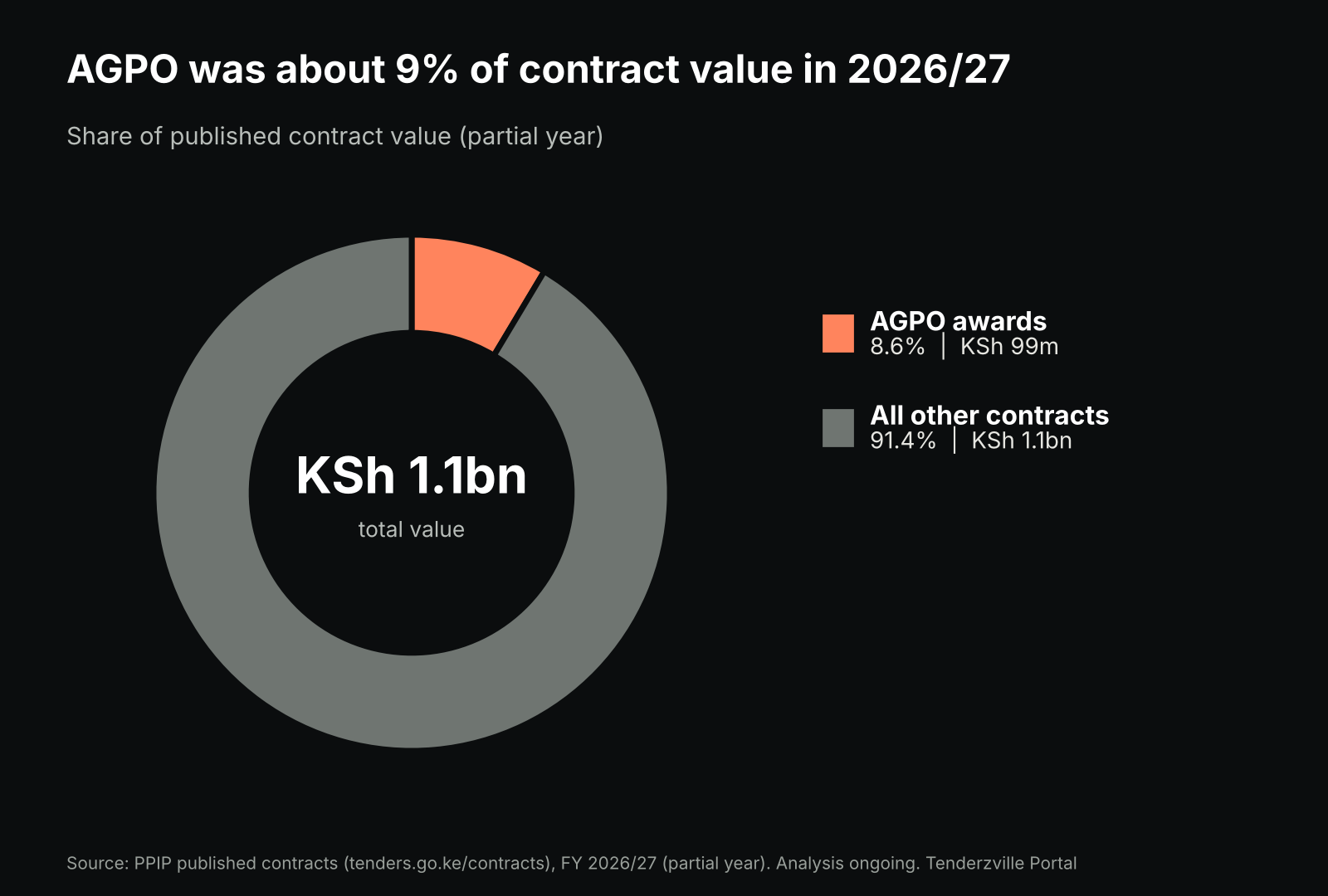
| Share of all published contract value | 9% | 10% | 17% | 9% |
| AGPO award value | KSh 26.8 billion | KSh 44.5 billion | KSh 32.2 billion | KSh 99 million |
| Median award with a stated value | KSh 432,000 | KSh 595,000 | KSh 1.4 million | KSh 114,000 |
| Awards under KSh 500,000 | 54% | 48% | 31% | 82% |
| Awards by quotation (RFQ) | 76% | 70% | 64% | 91% |
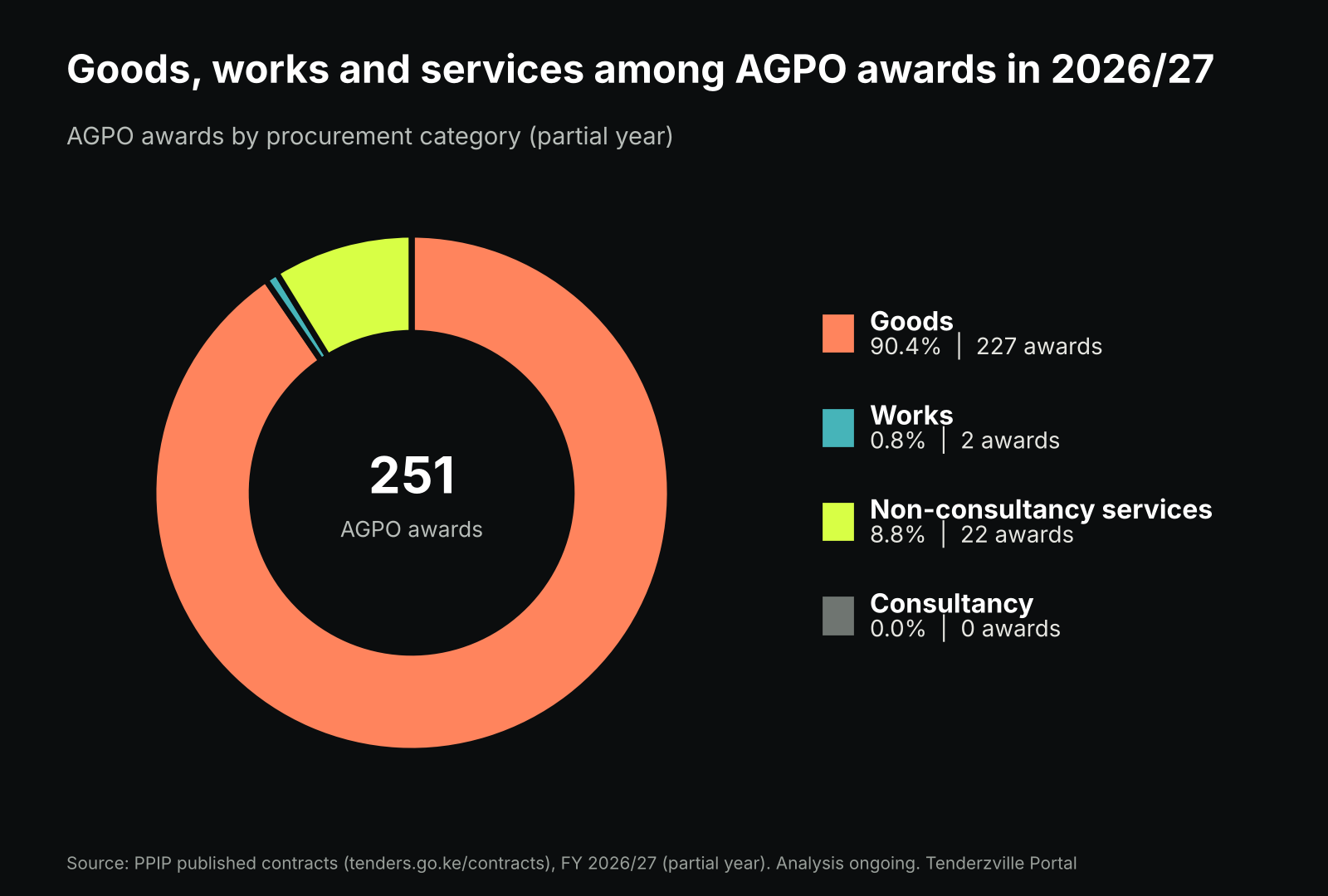
| Goods / works / services | 62% / 23% / 14% | 56% / 28% / 15% | 51% / 42% / 7% | 90% / 1% / 9% |
| Winning suppliers | 6,254 | 7,435 | 3,106 | 191 |
| Winners who sold to only one buyer | 88% | 87% | 94% | 99% |
2023/24 and 2024/25 are complete years. 2025/26 is still being published and 2026/27 covers awards to 13 October 2026, so compare them with care.
Jump to: year-by-year detail · what the news coverage adds · how suppliers get ahead · FAQ
How we analysed AGPO contracts in Kenya
We downloaded the published contracts from the PPIP contracts page for four financial years: 2023/24, 2024/25, 2025/26 and the early part of 2026/27. The exports hold every published contract, not only AGPO ones, so we flagged an award as AGPO when it carried an AGPO certificate number or an AGPO group (youth, women or persons with disabilities). We removed duplicate rows and left out zero-value entries, such as framework agreements, when working out typical award sizes.
The data tells us who won, from which buyer, by which method and for how much. It does not tell us whether a business was paid on time or made a profit, so we make no claims about either. If you are new to the programme, start with our guide on how to register for AGPO.
Finding 1: AGPO contracts in Kenya get a bigger share of contracts than of money
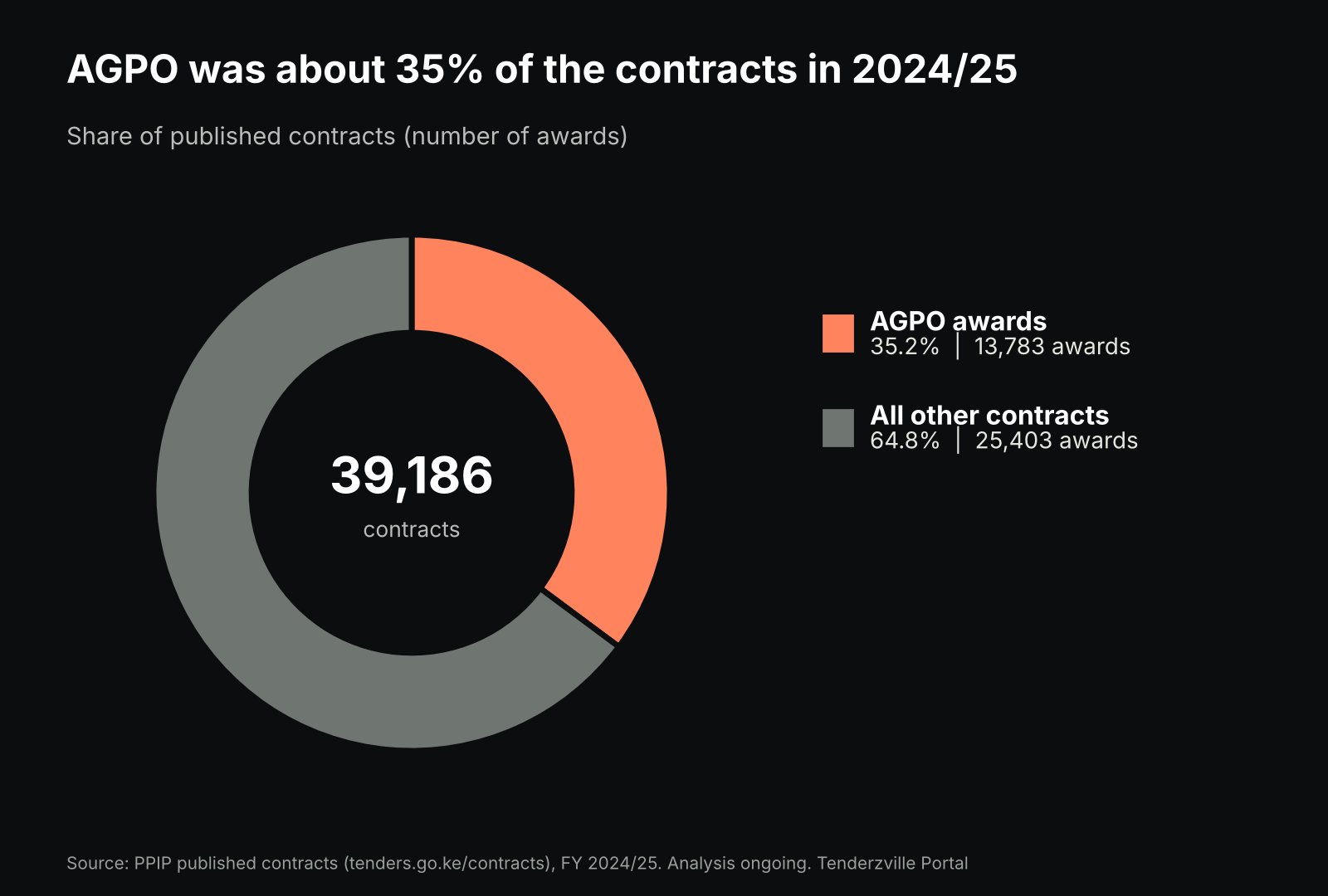
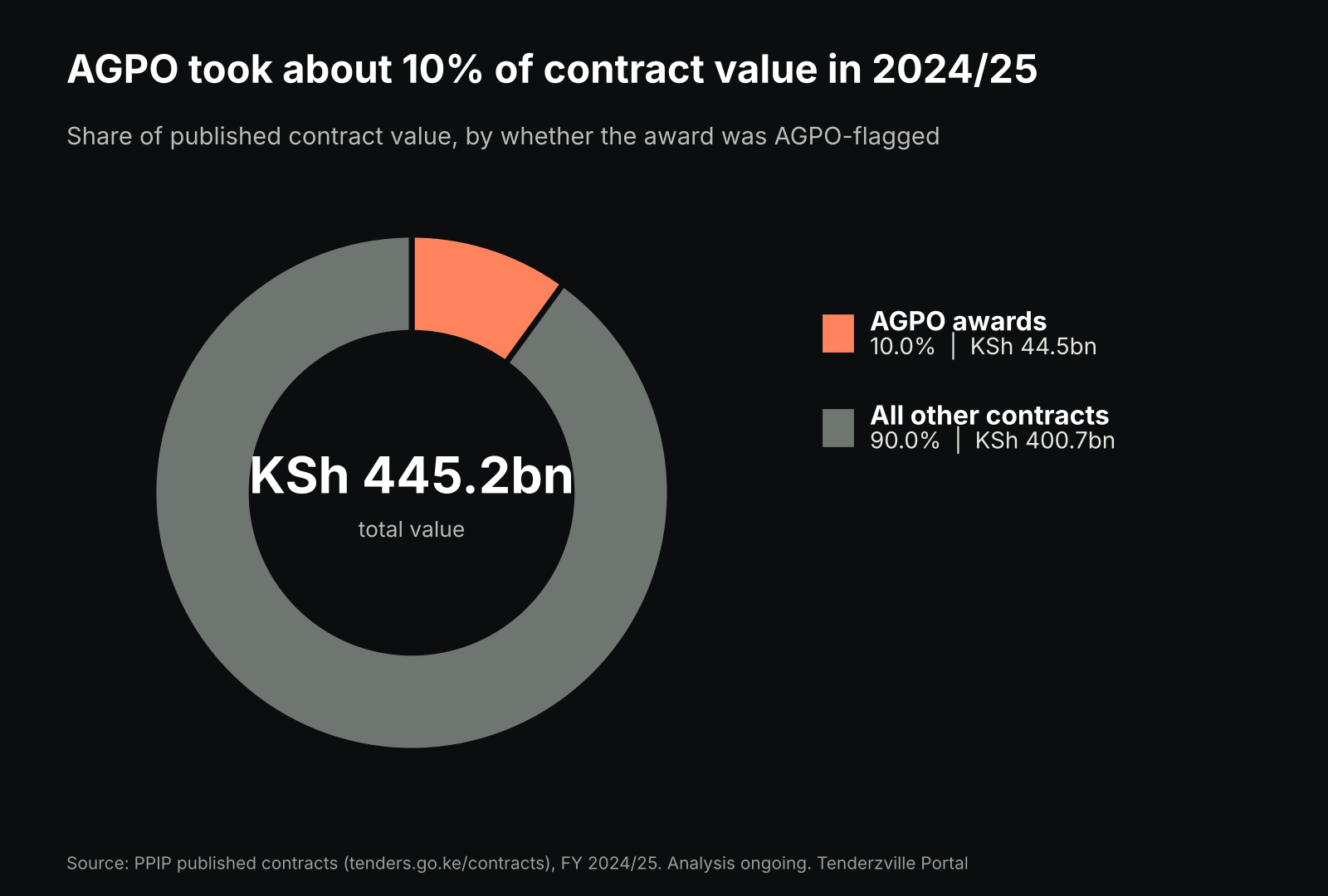
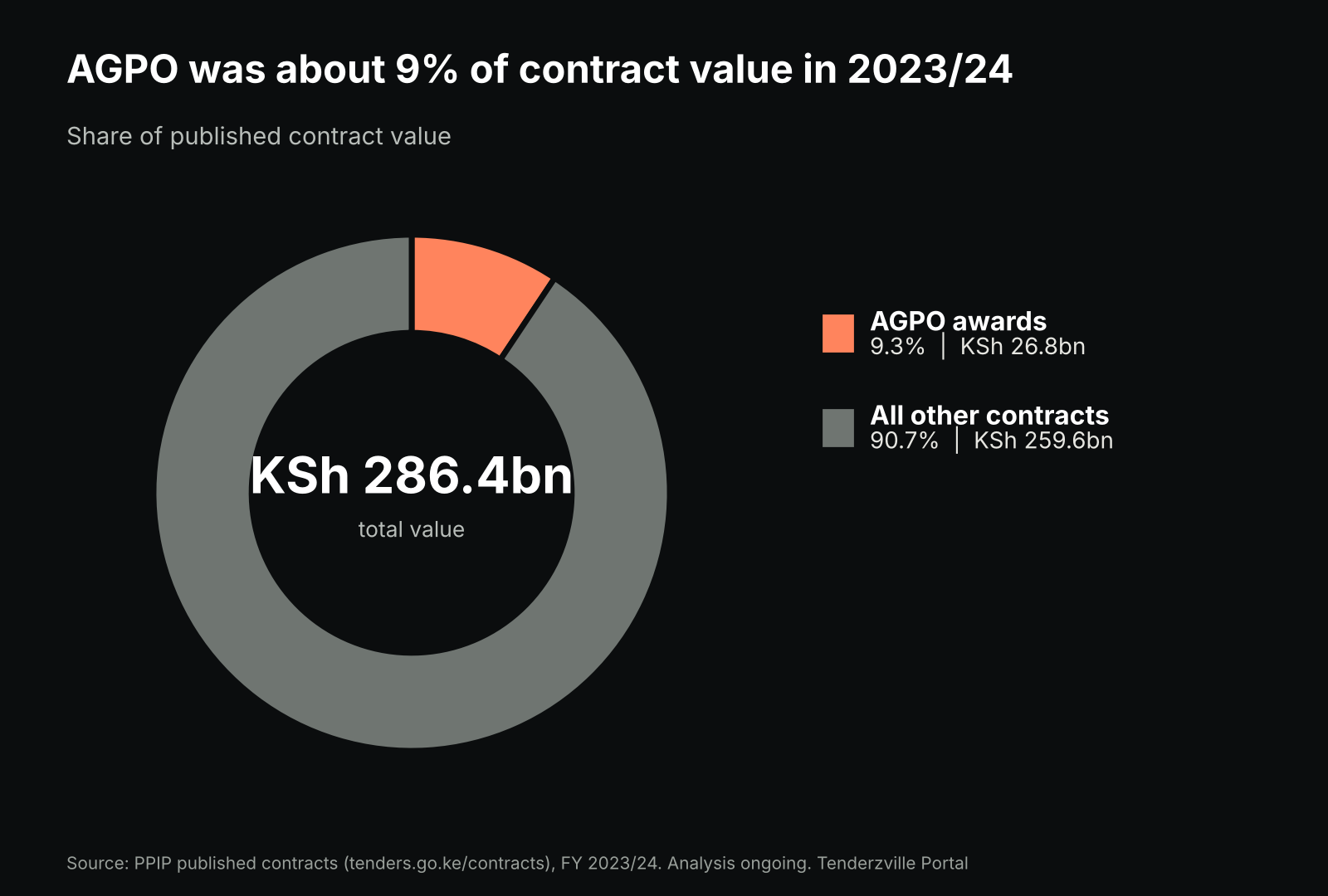
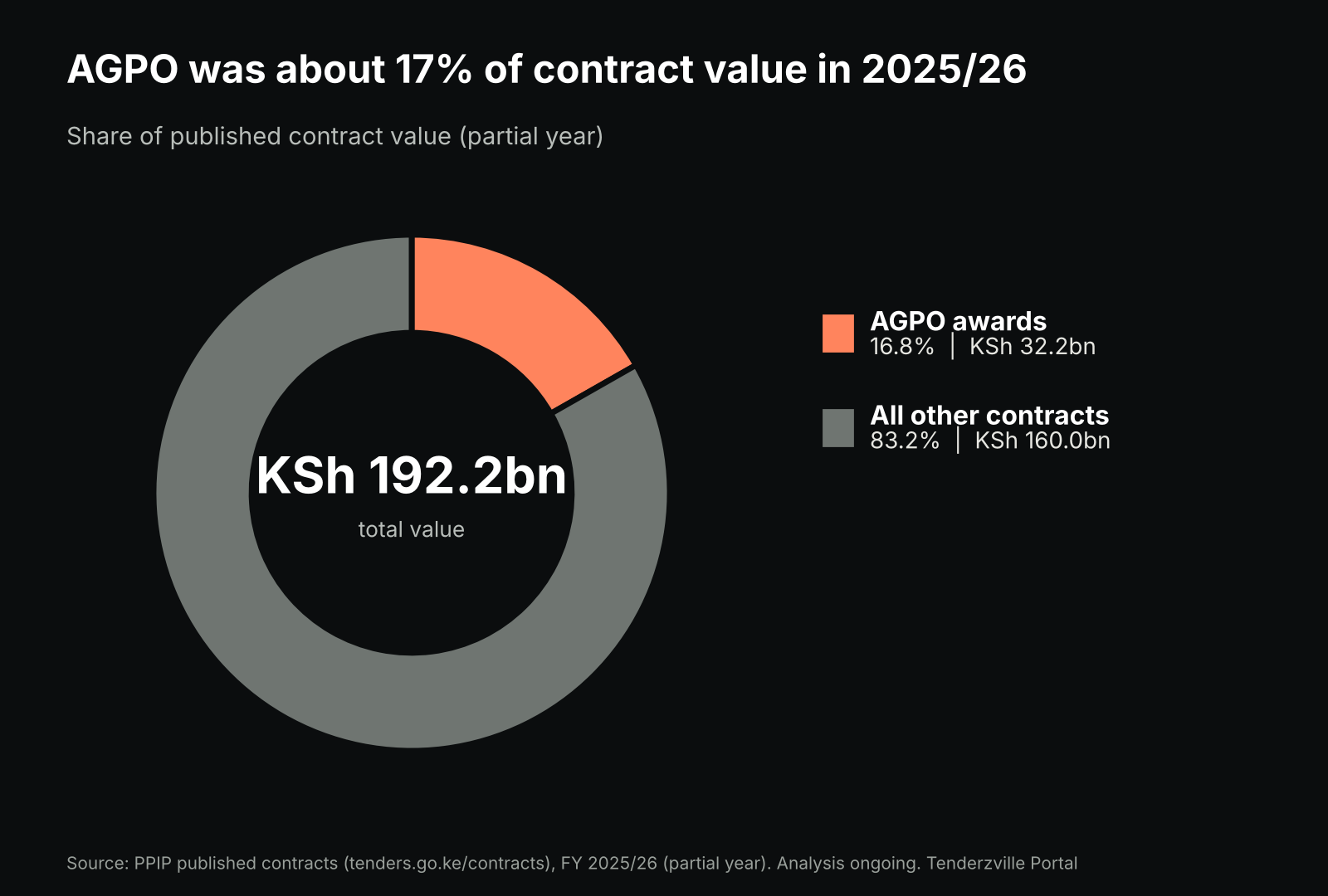
AGPO-flagged awards were about 34% to 39% of published contracts by number. By value, they were much smaller: about 9% in 2023/24, 10% in 2024/25 and about 17% in the part-published 2025/26.
- 2023/24: 34% of contracts, about 9% of value.
- 2024/25: 35% of contracts, about 10% of value.
- 2025/26 (partial): 39% of contracts, about 17% of value.
The 30% AGPO reservation is a target for procurement, and published records may not capture every award. Read the figures as a pattern in the published data, not a verdict on any one buyer. The share also differs by buyer type. In 2024/25, AGPO accounted for about 1% of the published value at state departments, about 10% at state corporations and about 22% at county governments.
Finding 2: most AGPO awards are small
In 2024/25, the median AGPO award with a stated value was about KSh 595,000, and about 48% were under KSh 500,000. In the early months of 2026/27 the median is about KSh 114,500, and 82% are under KSh 500,000. About half of the early 2026/27 quotation awards were under KSh 100,000.
For a supplier, this means a single AGPO certificate will rarely carry a business. Small orders are fine if you price them profitably, but you need many of them, from many buyers.
Finding 3: quotations and goods dominate AGPO contracts in Kenya
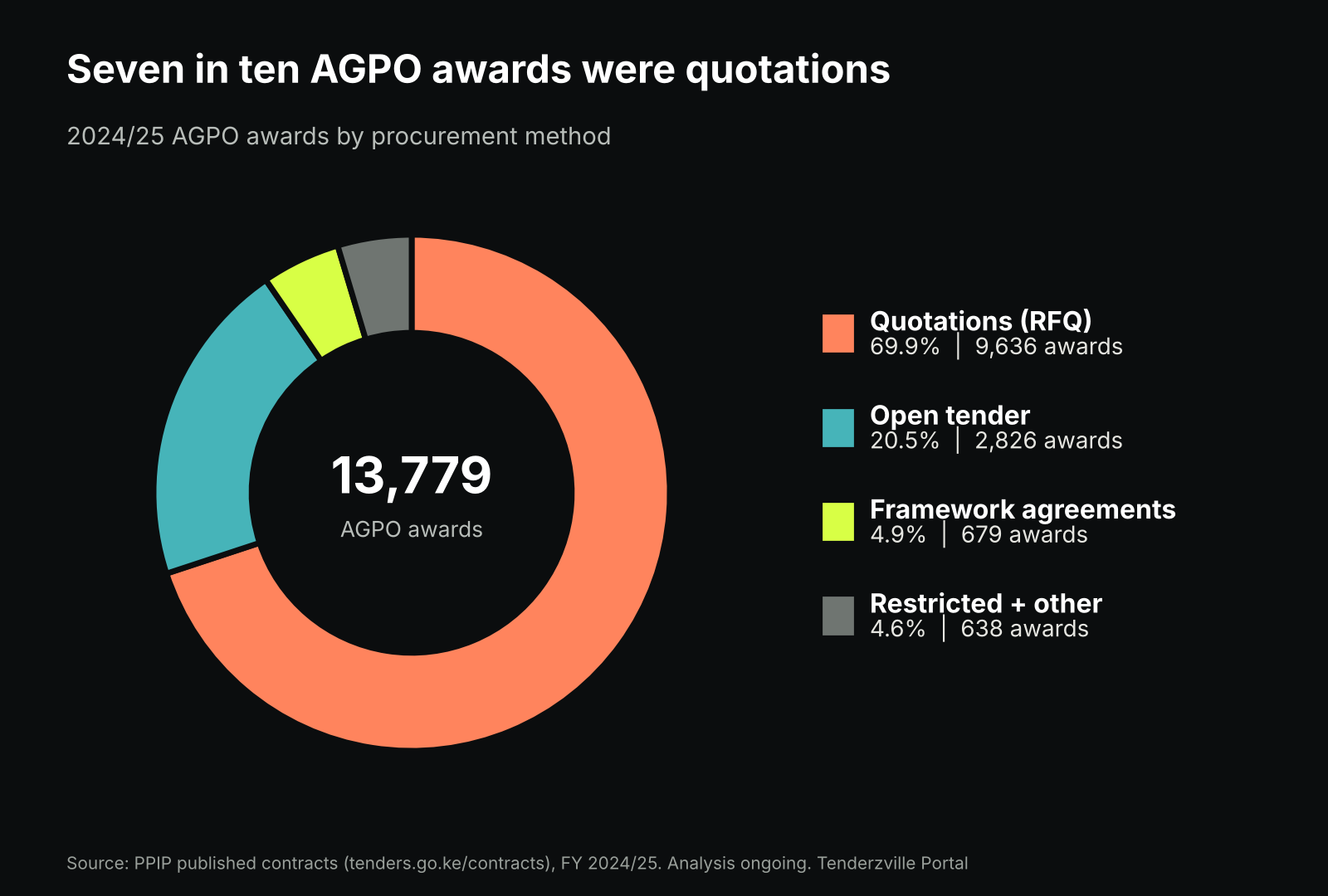
In 2024/25, about 70% of AGPO awards were requests for quotations (RFQs), about 56% were for goods and about 28% were works. In early 2026/27, about 91% are RFQs and about 90% are goods. Open tenders carry the larger contracts, but they are a smaller share of the awards.
The items bought most often through AGPO quotations in early 2026/27 were office supplies and stationery, catering and hospitality, training materials, sanitary and cleaning supplies, and computer equipment. If you supply these, a quotation template and a ready price list are the tools that win work. Our guide on how to respond to an RFQ walks through the steps.
Finding 4: most winners win once
About 68% of the AGPO winners in 2024/25 won a single contract that year. Only 37% of the 2023/24 winners won an AGPO award again in 2024/25. In other words, repeat business is the exception, not the rule, when it comes to AGPO contracts in Kenya.
The work also starts fast. In early 2026/27, the median AGPO contract started about 2 days after award, and the median contract lasted about 9 days. A supplier who answers a quotation late, or cannot produce documents quickly, loses the work.
Finding 5: most winners sell to only one buyer
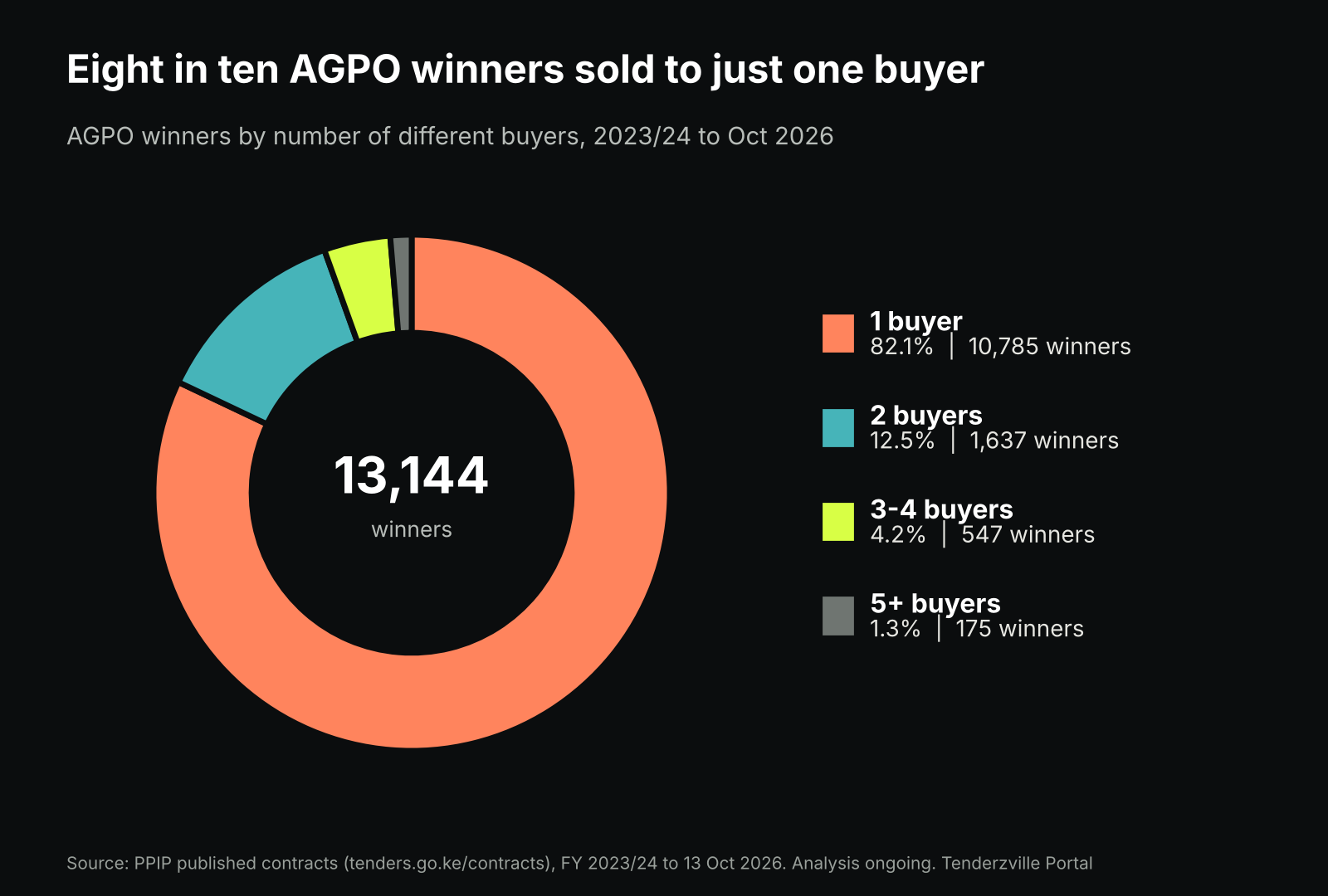
Across the records, about 82% of AGPO winners (10,785 of 13,144) sold to only one buyer. The 175 winners who sold to five or more buyers had a median total of about KSh 6.1 million in awards, compared with about KSh 1.7 million for winners who sold to a single buyer.
That does not prove that more buyers cause bigger income. Larger firms may simply have more buyers. But it shows where the larger income sits, and it is the strongest argument for spreading your risk instead of relying on one government entity.
Finding 6: women-owned businesses take the most AGPO awards
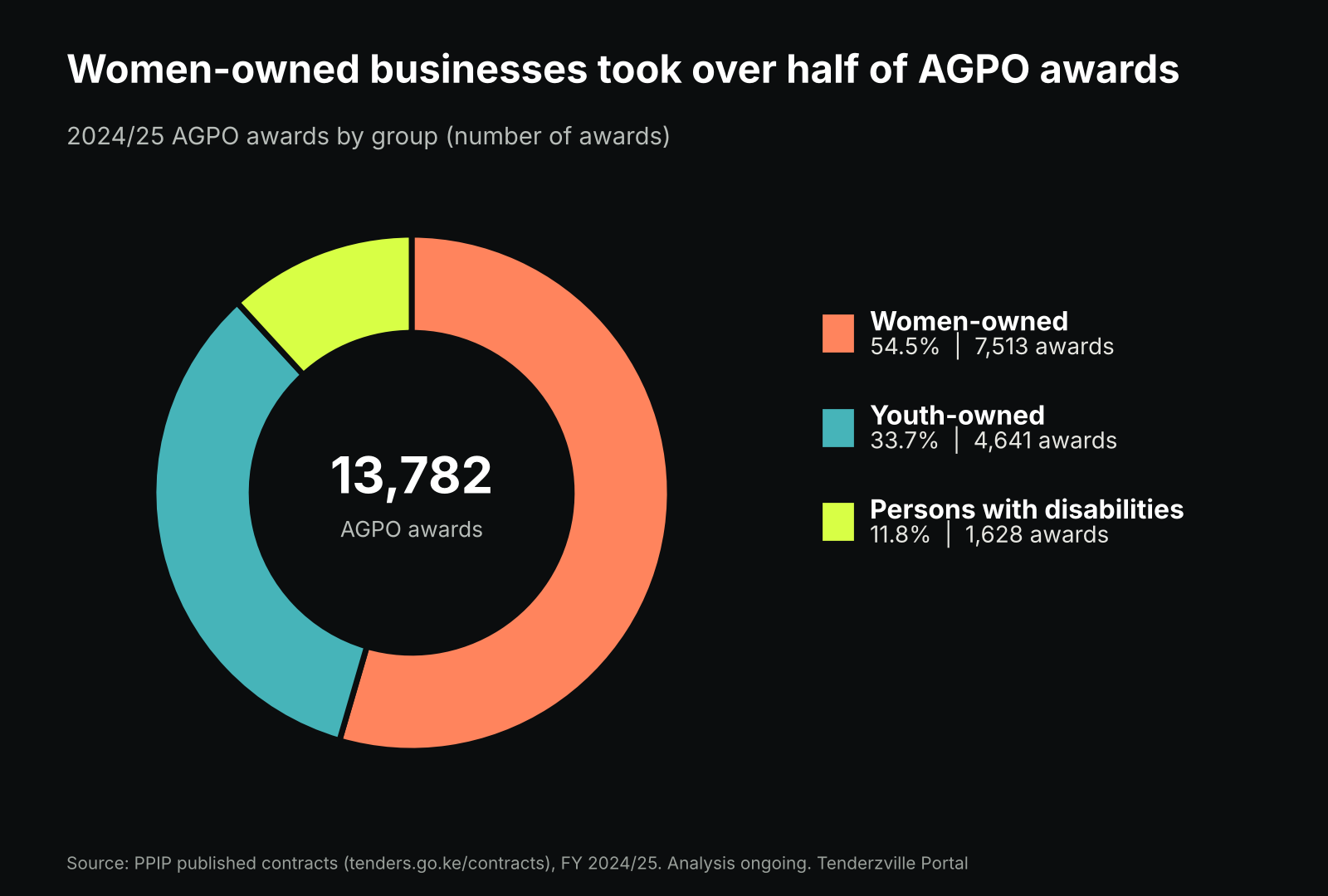
In 2024/25, women-owned businesses took about 54% of AGPO awards by number, youth-owned businesses about 34% and businesses owned by persons with disabilities about 12%. Whichever group you belong to, choose the category that truly matches your ownership and keep your documents consistent. Winning AGPO contracts in Kenya is a matter of being ready and being visible, whichever group you belong to.
What AGPO contracts in Kenya are for: year-by-year detail
We grouped AGPO awards by what was bought, using the tender titles, for every financial year in the data. The grouping is by keyword, so treat the shares as approximate, and about a quarter of goods awards in the complete years did not match any category. Non-consultancy services were bought too, and the workbook has the breakdown. Here is each year in turn, starting with the oldest.
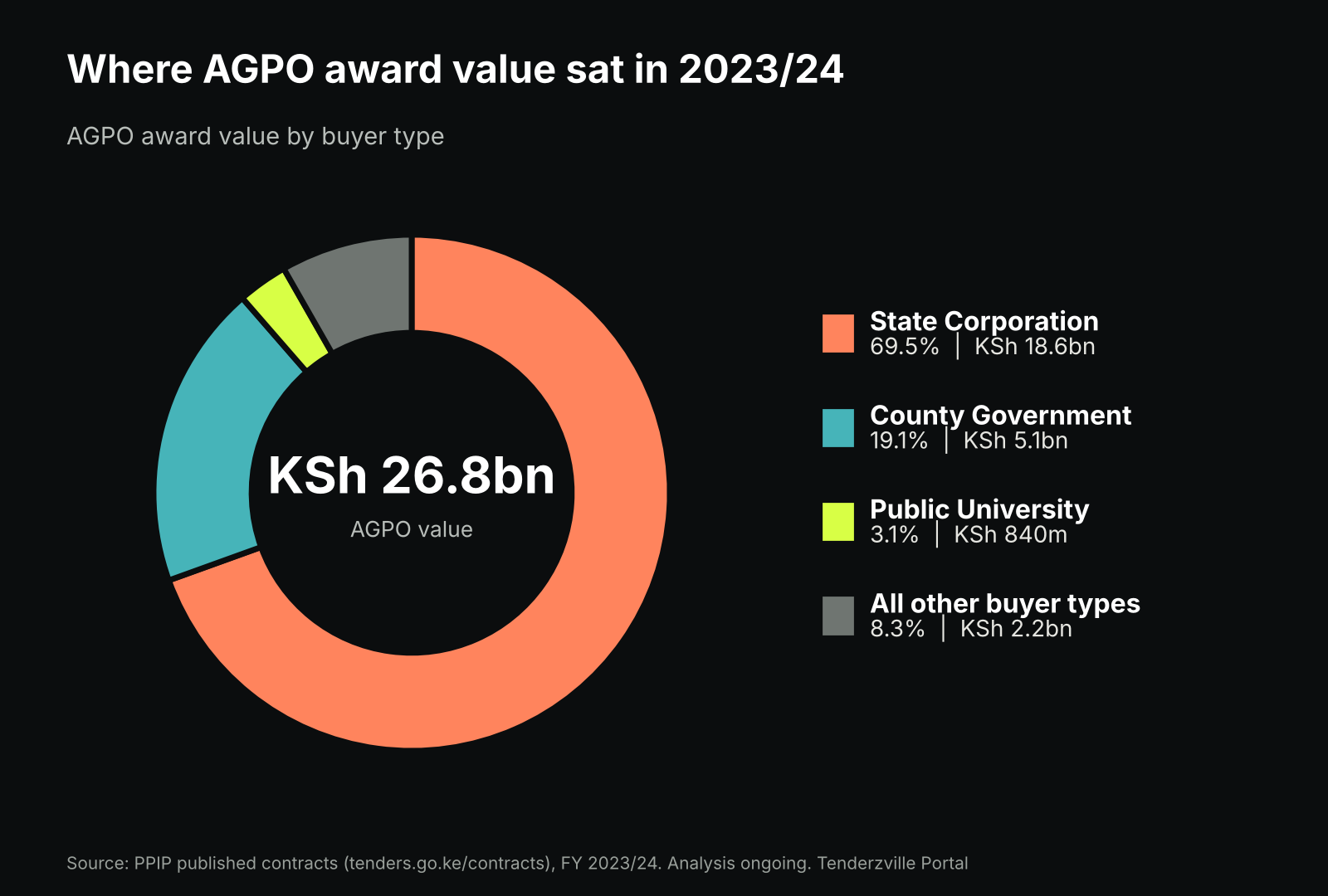
2023/24 (complete year): 11,834 AGPO awards worth about KSh 26.8 billion
AGPO-flagged awards were about 34% of published contracts by number and about 9% by value. The median award with a stated value was about KSh 432,000, and about 54% were under KSh 500,000. About 76% were quotations, with 62% for goods, 23% for works and 14% for non-consultancy services. 6,254 businesses won, and about 68% of them won only one contract.
By group:
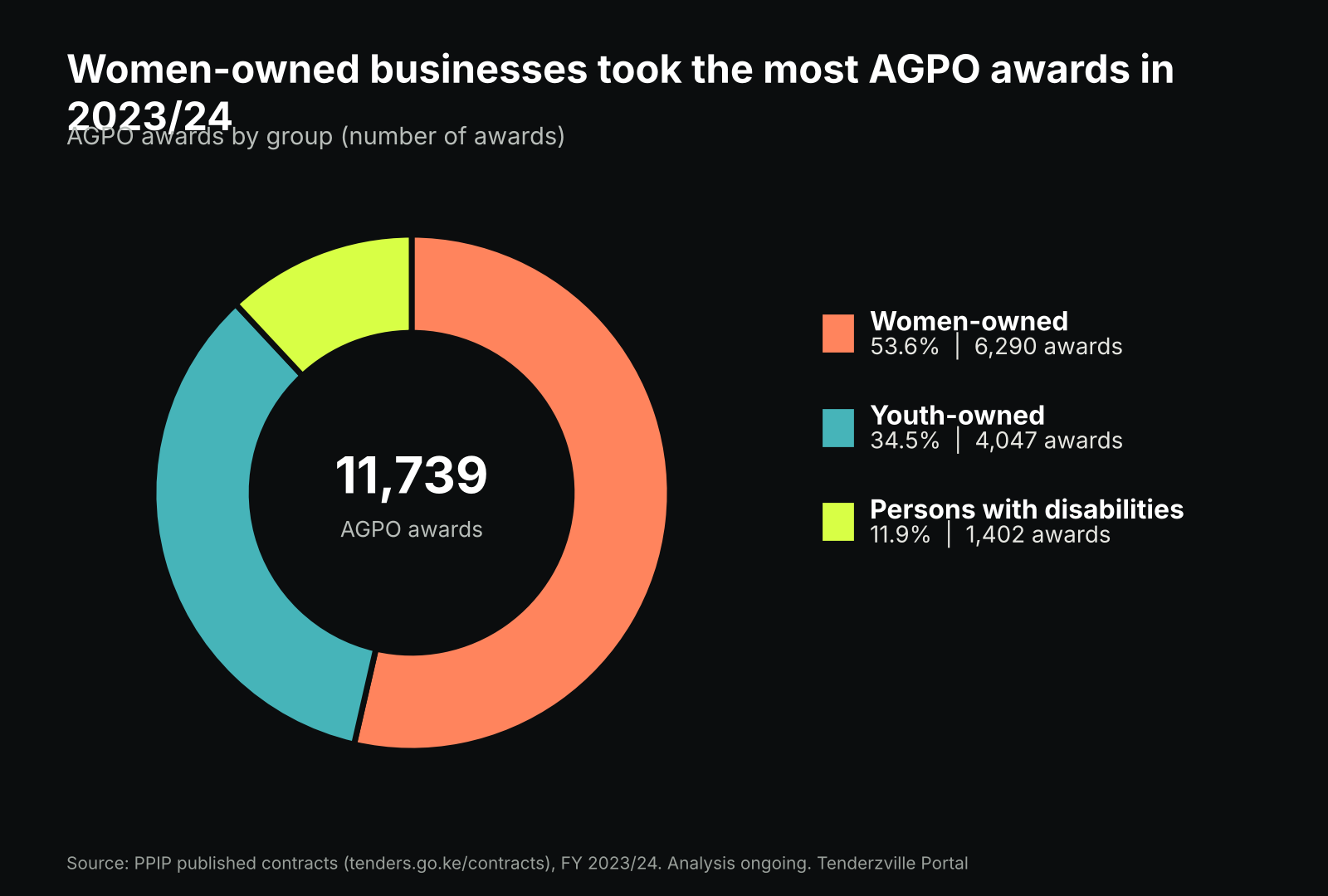
- Women-owned: 6,290 awards (54%), median award about KSh 333,000.
- Youth-owned: 4,047 awards (34%), median award about KSh 596,000.
- Persons with disabilities: 1,402 awards (12%), median award about KSh 509,000.
Goods most often bought:
- Catering, food and hospitality: about 15% of goods awards, median about KSh 54,000.
- Stationery and office supplies: about 14% of goods awards, median about KSh 300,000.
- Printing, branding and uniforms: about 8% of goods awards, median about KSh 272,000.
- Computers, ICT and electronics: about 8% of goods awards, median about KSh 499,000.
- Electrical and mechanical: about 6% of goods awards, median about KSh 514,000.
- Building materials and hardware: about 5% of goods awards, median about KSh 183,000.
Types of works:
- Roads, drainage and bridges: about 34% of works awards, median about KSh 4.3 million.
- Water, boreholes and sanitation works: about 22% of works awards, median about KSh 2.2 million.
- Buildings and classrooms: about 18% of works awards, median about KSh 2.2 million.
- Renovation, repair and maintenance: about 9% of works awards, median about KSh 2.5 million.
Buyers: the most AGPO awards came from Kenya Rural Roads Authority (783), Kenya Medical Research Institute (402), PC Kinyanjui Technical Training Institute (378). AGPO accounted for about 13% of published value at county governments and about 10% at state corporations.
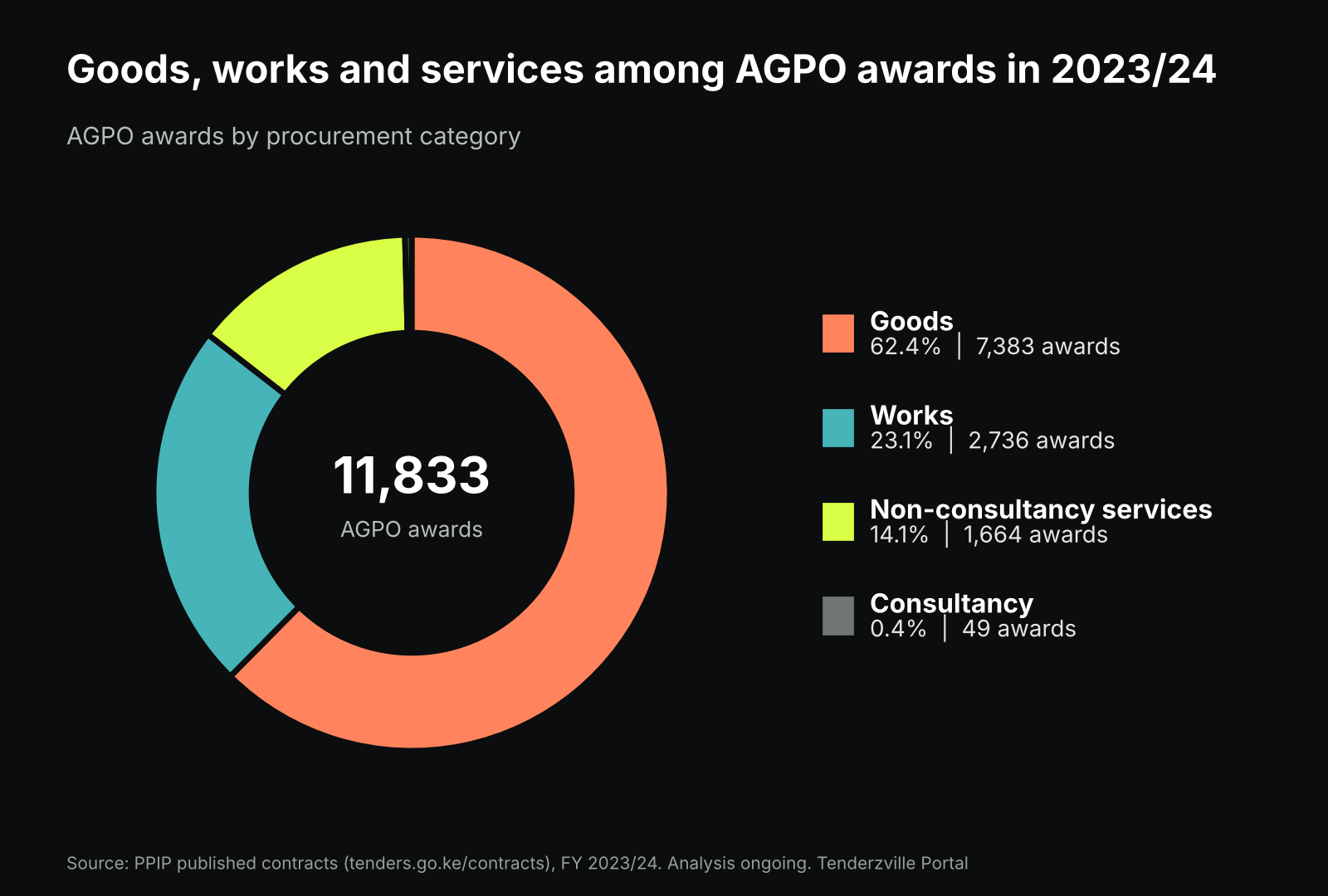
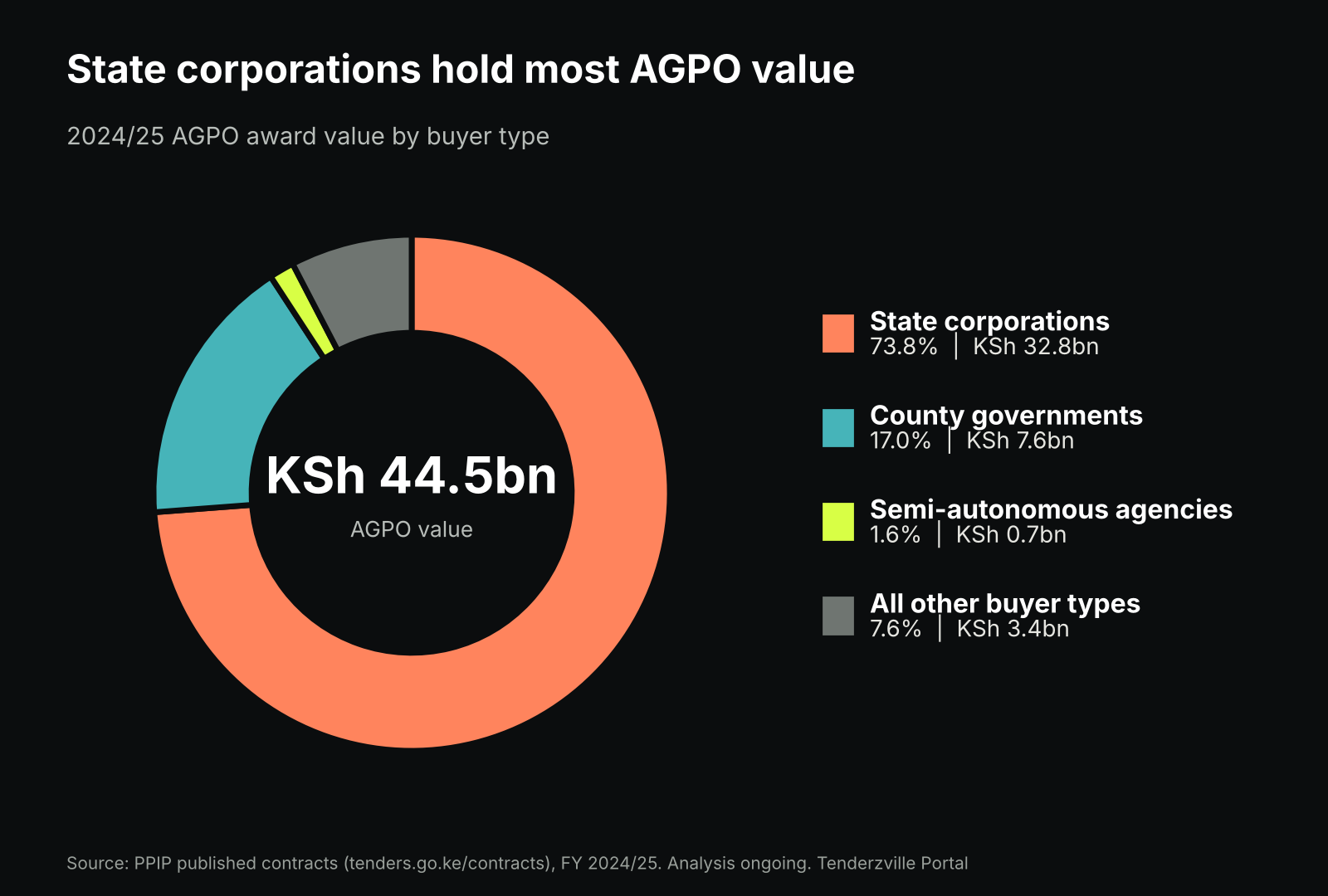
2024/25 (complete year): 13,783 AGPO awards worth about KSh 44.5 billion
AGPO-flagged awards were about 35% of published contracts by number and about 10% by value. The median award with a stated value was about KSh 595,000, and about 48% were under KSh 500,000. About 70% were quotations, with 56% for goods, 28% for works and 15% for non-consultancy services. 7,435 businesses won, and about 68% of them won only one contract.
By group:
- Women-owned: 7,513 awards (55%), median award about KSh 445,000.
- Youth-owned: 4,641 awards (34%), median award about KSh 852,000.
- Persons with disabilities: 1,628 awards (12%), median award about KSh 763,000.
Goods most often bought:
- Stationery and office supplies: about 16% of goods awards, median about KSh 350,000.
- Catering, food and hospitality: about 13% of goods awards, median about KSh 108,000.
- Computers, ICT and electronics: about 9% of goods awards, median about KSh 498,000.
- Printing, branding and uniforms: about 9% of goods awards, median about KSh 330,000.
- Electrical and mechanical: about 6% of goods awards, median about KSh 465,000.
- Building materials and hardware: about 5% of goods awards, median about KSh 200,000.
Types of works:
- Roads, drainage and bridges: about 38% of works awards, median about KSh 5.0 million.
- Buildings and classrooms: about 19% of works awards, median about KSh 2.0 million.
- Water, boreholes and sanitation works: about 18% of works awards, median about KSh 3.0 million.
- Renovation, repair and maintenance: about 9% of works awards, median about KSh 3.6 million.
Buyers: the most AGPO awards came from Kenya Rural Roads Authority (1,015), Nakuru County Government (492), PC Kinyanjui Technical Training Institute (366). AGPO accounted for about 22% of published value at county governments and about 10% at state corporations.
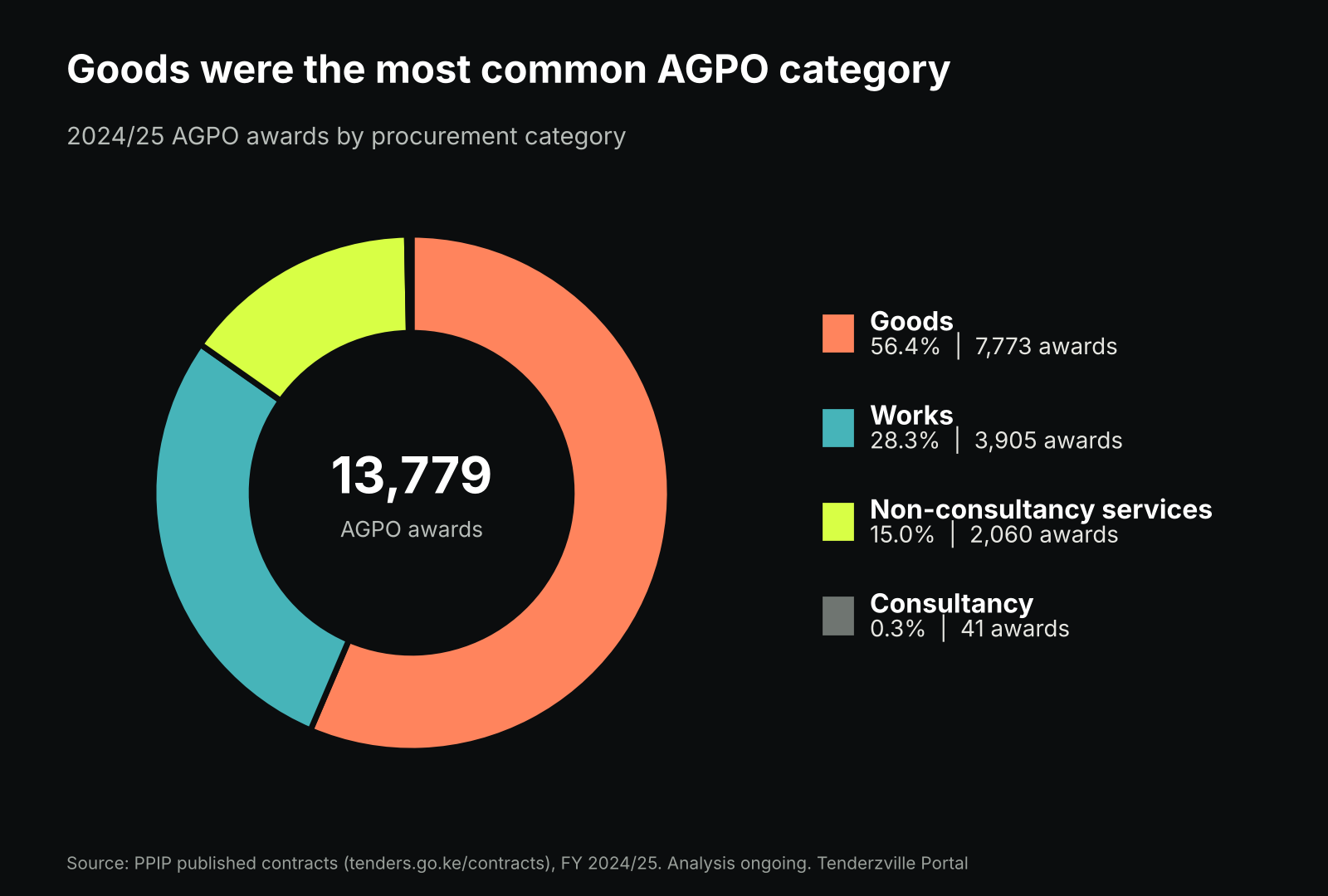
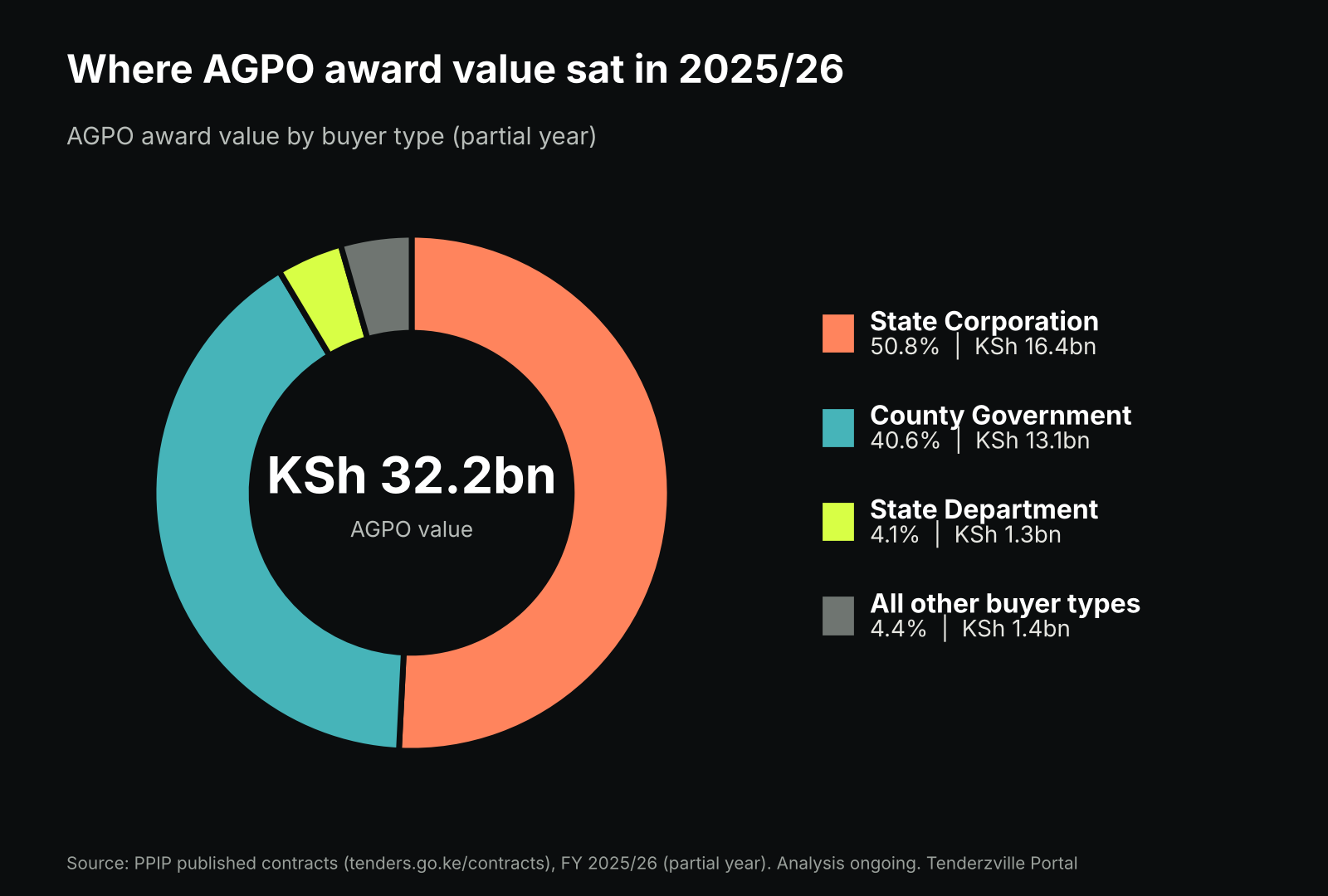
2025/26 (partial year): 4,652 AGPO awards worth about KSh 32.2 billion
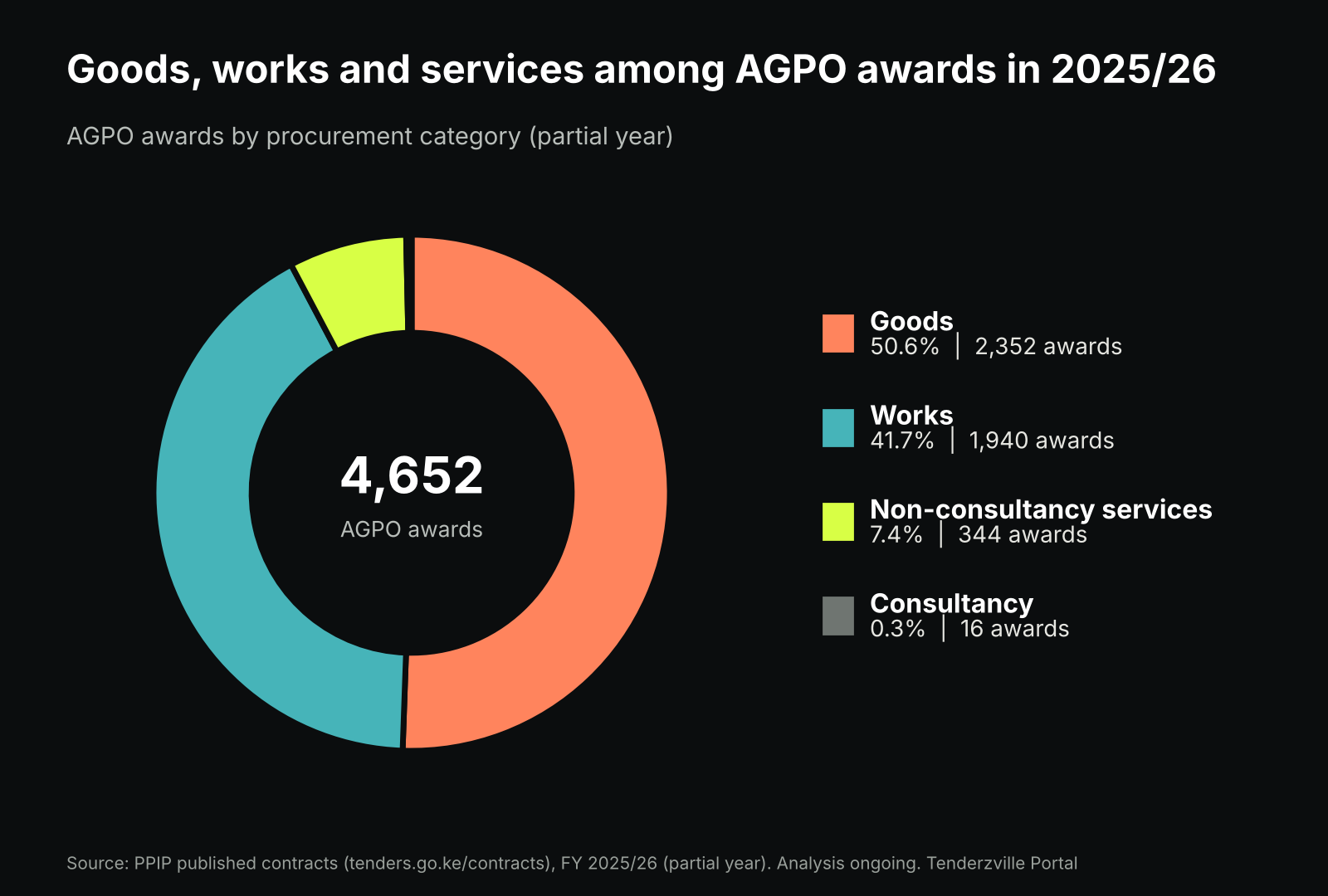
AGPO-flagged awards were about 39% of published contracts by number and about 17% by value. The median award with a stated value was about KSh 1.4 million, and about 31% were under KSh 500,000. About 64% were quotations, with 51% for goods, 42% for works and 7% for non-consultancy services. 3,106 businesses won, and about 74% of them won only one contract.
By group:
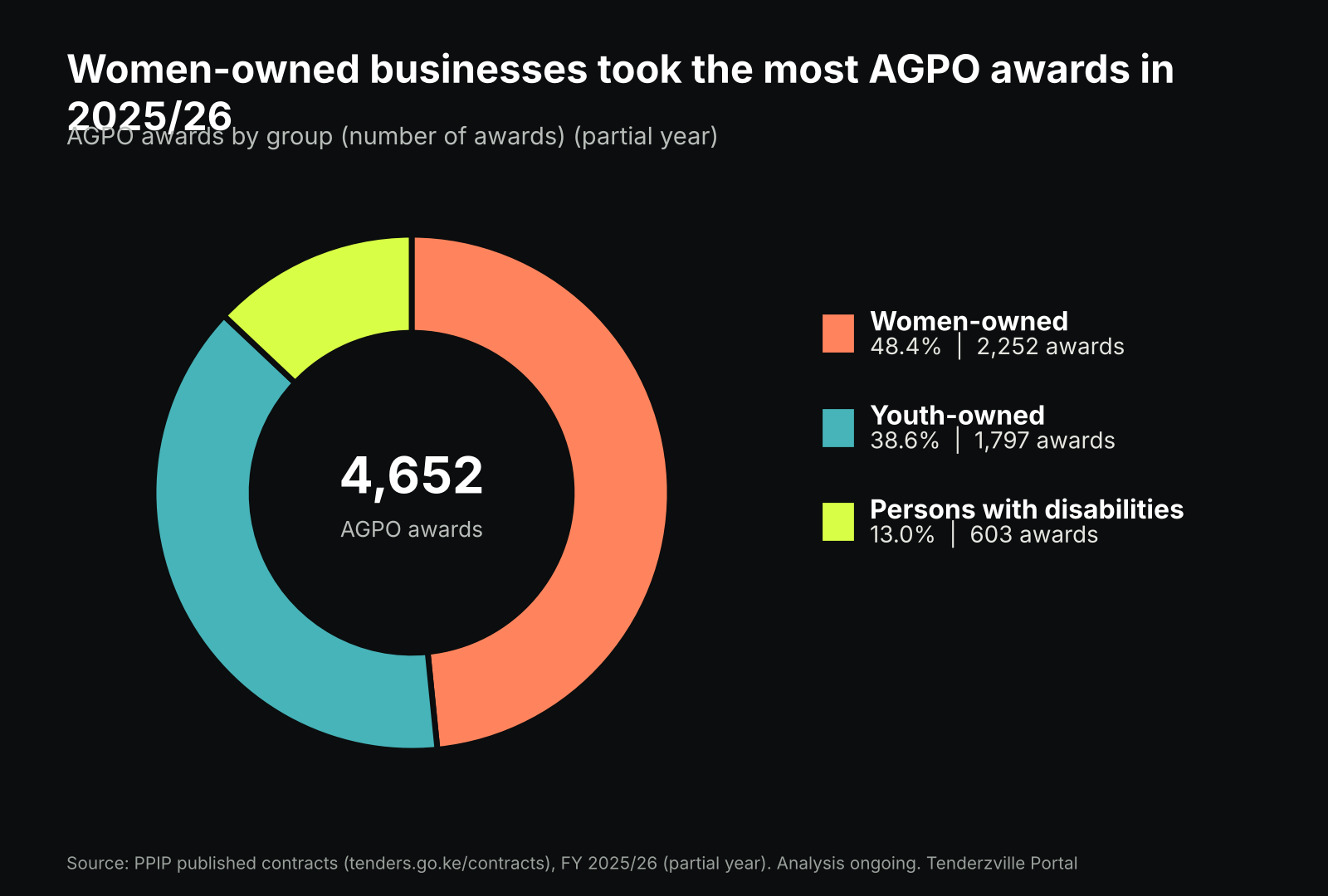
- Women-owned: 2,252 awards (48%), median award about KSh 1.4 million.
- Youth-owned: 1,797 awards (39%), median award about KSh 1.5 million.
- Persons with disabilities: 603 awards (13%), median award about KSh 1.7 million.
Goods most often bought so far:
- Stationery and office supplies: about 16% of goods awards, median about KSh 324,000.
- Computers, ICT and electronics: about 11% of goods awards, median about KSh 370,000.
- Catering, food and hospitality: about 9% of goods awards, median about KSh 165,000.
- Printing, branding and uniforms: about 7% of goods awards, median about KSh 672,000.
- Electrical and mechanical: about 7% of goods awards, median about KSh 932,000.
- Agriculture, livestock and farm inputs: about 5% of goods awards, median about KSh 1.0 million.
Types of works:
- Roads, drainage and bridges: about 39% of works awards, median about KSh 5.0 million.
- Water, boreholes and sanitation works: about 22% of works awards, median about KSh 2.9 million.
- Buildings and classrooms: about 18% of works awards, median about KSh 2.3 million.
- Renovation, repair and maintenance: about 8% of works awards, median about KSh 3.0 million.
Buyers: the most AGPO awards came from The Judiciary (435), Kenya Rural Roads Authority (418), Kwale County Government (268). AGPO accounted for about 42% of published value at county governments and about 11% at state corporations.
2026/27 (early months, to 13 October 2026): 251 AGPO awards worth about KSh 99 million
AGPO-flagged awards were about 45% of published contracts by number and about 9% by value. The median award with a stated value was about KSh 114,000, and about 82% were under KSh 500,000. About 91% were quotations, with 90% for goods, 1% for works and 9% for non-consultancy services. 191 businesses won, and about 77% of them won only one contract.
By group:
- Women-owned: 122 awards (49%), median award about KSh 114,000.
- Youth-owned: 100 awards (40%), median award about KSh 133,000.
- Persons with disabilities: 29 awards (12%), median award about KSh 57,000.
Goods most often bought so far:
- Catering, food and hospitality: about 28% of goods awards, median about KSh 97,000.
- Stationery and office supplies: about 28% of goods awards, median about KSh 98,000.
- Computers, ICT and electronics: about 11% of goods awards, median about KSh 65,000.
- Cleaning, sanitary and hygiene: about 10% of goods awards, median about KSh 43,000.
- Printing, branding and uniforms: about 4% of goods awards, median about KSh 114,000.
- Electrical and mechanical: about 4% of goods awards, median about KSh 58,000.
Only a handful of works awards have been published so far, so there is no works breakdown yet.
Buyers: the most AGPO awards came from The Judiciary (117), Kakrao Technical & Vocational College (17), Kenya Institute of Supplies Management (13).
What stays the same: across the complete years, stationery, catering and ICT were always among the most common goods, roads and drainage were always the largest type of works, and women-owned businesses always took about half or more of the awards. What changes is the mix of small and large awards, which is why a single certificate cannot be your only plan.
Supply any of these? Get found on Source.ke
Whether you sell stationery, catering, ICT equipment, cleaning supplies, building materials or works services, list it on a free Source.ke profile with your compliance documents so more than one buyer can find you and send RFQs. Source.ke cannot promise contracts, and you should always do your own due diligence, but it widens the set of buyers who can reach you.
List your products or services on Source.ke Get TenderPro alerts
What the news coverage adds to the AGPO numbers
Our analysis uses the published contracts data. News reports use other sources, and the two measure slightly different things, so they are not directly comparable. They do point the same way, and they add context.
- Single buyers can move the totals. Business Daily reported that Kenya Power gave out tenders worth Sh3.5 billion to youth, women and persons with disabilities in the year to June 2025, more than four times the Sh614 million of the year before. In our data, state corporations and county governments together account for most of the AGPO value in 2024/25 and 2025/26.
- The national totals are large. Business Daily reported that contracts to women, youth and persons with disabilities reached a record Sh45.1 billion in the year to June 2023, citing official statistics, and linked the rise to reforms that reveal the beneficial owners of companies that win public tenders. Our PPIP-based figures for AGPO-flagged awards are about KSh 26.8 billion in 2023/24 and KSh 44.5 billion in 2024/25. The sources and years differ, so do not read them as one series.
- Women win many contracts but smaller ones. The Nation’s analysis, A promise unfulfilled, summarises that women entrepreneurs, though winning a high number of contracts, are confined to low-value tenders. Our data shows the same shape: in 2024/25 women-owned businesses took 55% of AGPO awards, with a median award of about KSh 445,000, against about KSh 852,000 for youth-owned businesses. In 2023/24 the medians were about KSh 333,000 and KSh 596,000.
Practical guides add the rules and habits that go with the numbers. Huduma Global, for example, advises suppliers to register early, keep tax and registration documents ready because a missing document can disqualify a bid, start with requests for quotations, consider partnering or subcontracting, and watch county procurement plans. It also cites rules such as 70% ownership by the qualifying group and payment within 30 days of invoice. Treat third-party summaries of the rules as a starting point and check the current requirements on the official portals.
Why this matters for your business
Many suppliers register for AGPO and expect a steady stream of work. The published numbers suggest a different picture. AGPO contracts in Kenya are plentiful in number, but each one is usually small, and the buyer who gave you one award may not give you another. A business that treats the certificate as a guarantee can spend a year waiting for work that never repeats.
The suppliers who do best in the records are not necessarily the ones with the biggest single award. They are the ones who show up in front of several buyers, respond quickly and keep their paperwork in order. That is a strategy you control, whatever the buying pattern of any single entity, and it is why we recommend building more than one source of income alongside AGPO.
How suppliers get ahead with AGPO contracts
Putting the data and the coverage together, these are the moves that separate suppliers who keep winning from those who win once:
- Go where the AGPO share is higher. In 2024/25, AGPO made up about 22% of published value at county governments, against about 10% at state corporations and about 1% at state departments. Register with your county and read its annual procurement plan.
- Learn the repeat buyers. The Kenya Rural Roads Authority issued the most AGPO awards in both 2023/24 and 2024/25, and the Judiciary has led in 2025/26 and 2026/27 so far. Some buyers award AGPO work again and again, so understand what they buy and when.
- Climb the value ladder. Typical award sizes differ widely by category. In 2024/25, the median award for medical and laboratory goods was about KSh 835,000, against about KSh 108,000 for catering. Women-owned businesses in particular can look at categories with larger medians.
- Partner or subcontract for works. Works awards are fewer but larger, with typical awards of KSh 2 million to KSh 5 million in 2024/25. Joining an established contractor is a way to build a track record.
- Be document-ready. Keep your registration, tax compliance certificate, price list and past-work references ready, because contracts start within days of award.
- Price realistically and play fair. Bids priced too high or suspiciously low draw attention, and collusion or bribery can lead to being barred from public tenders.
- Do not depend on AGPO alone. About 82% of winners sold to only one buyer. Add private and NGO buyers, for example through Source.ke.
What suppliers should do about AGPO contracts in Kenya
- Treat AGPO as one income stream, not the whole business. Most awards are small and one-off.
- Aim for at least three buyers in different buyer types. For example, a college, a county government and a private company.
- Be fast. Keep your registration documents, tax compliance certificate and price list ready, because contracts can start within days of award.
- Quote profitably. Know your delivery costs before you send a quotation.
- Look beyond government. Private companies and NGOs buy through RFQs as well.
- Register on eGP. AGPO qualifies you for reserved tenders, but you also need eGP registration to bid.
Get found by more than one buyer
Winning AGPO contracts in Kenya is easier when buyers can find you. Source.ke lets suppliers keep their compliance documents on a profile and receive RFQs from private buyers, so you are not relying on one government entity. It cannot promise you contracts, and you should always run your own due diligence, but it widens the set of buyers who can find you.
Where to find AGPO contracts in Kenya
Government buyers advertise through the eGP system, and many also use quotations sent to a small list of suppliers. Set up alerts so you see requests early, and read our guides to tenders in Kenya and the best procurement marketplaces for Kenyan businesses to build more than one source of work. Start from the Kenya Supply Chain Hub if you are not sure where to begin.
More reading on AGPO
News coverage of AGPO usually focuses on single buyers. Business Daily reported on Kenya Power’s tenders won by youth and women, on record government tenders going to youth and women, and the Nation examined why the programme still falls short for many women, youth and persons with disabilities. Our analysis looks at the whole published dataset instead of one buyer, so you can see the pattern across all of them. The source data is on the PPIP contracts page.
Limits of this analysis of AGPO contracts in Kenya
- The exports are from the PPIP contracts page and are only as complete as what buyers publish.
- 2025/26 and 2026/27 are partial years, so do not compare them directly with 2023/24 and 2024/25.
- Some award dates contain typing errors, so we grouped by financial year.
- Supplier names were cleaned for case and punctuation but not matched fuzzily, so one firm may appear under two spellings.
- The data does not show payment times or profit.
We will keep updating this analysis. Join the Supply Chain Coded newsletter to see the next update.
Frequently asked questions
Q: How many AGPO contracts in Kenya were awarded?
A: In the published records we analysed, about 11,800 in 2023/24 and about 13,800 in 2024/25, with 2025/26 and 2026/27 still being published.
Q: What share of government contract value goes to AGPO businesses?
A: About 9% to 10% in the complete years we analysed, though published records may not capture every award.
Q: How big is a typical AGPO award?
A: The median award with a stated value was about KSh 595,000 in 2024/25, and about KSh 114,500 in early 2026/27.
Q: Do AGPO winners keep winning?
A: Not usually. About 37% of 2023/24 winners won another AGPO award in 2024/25.
Q: Do AGPO contracts in Kenya go to every certificate holder?
A: No. An AGPO certificate lets you compete for reserved tenders. You still have to meet the requirements and compete on price and quality.