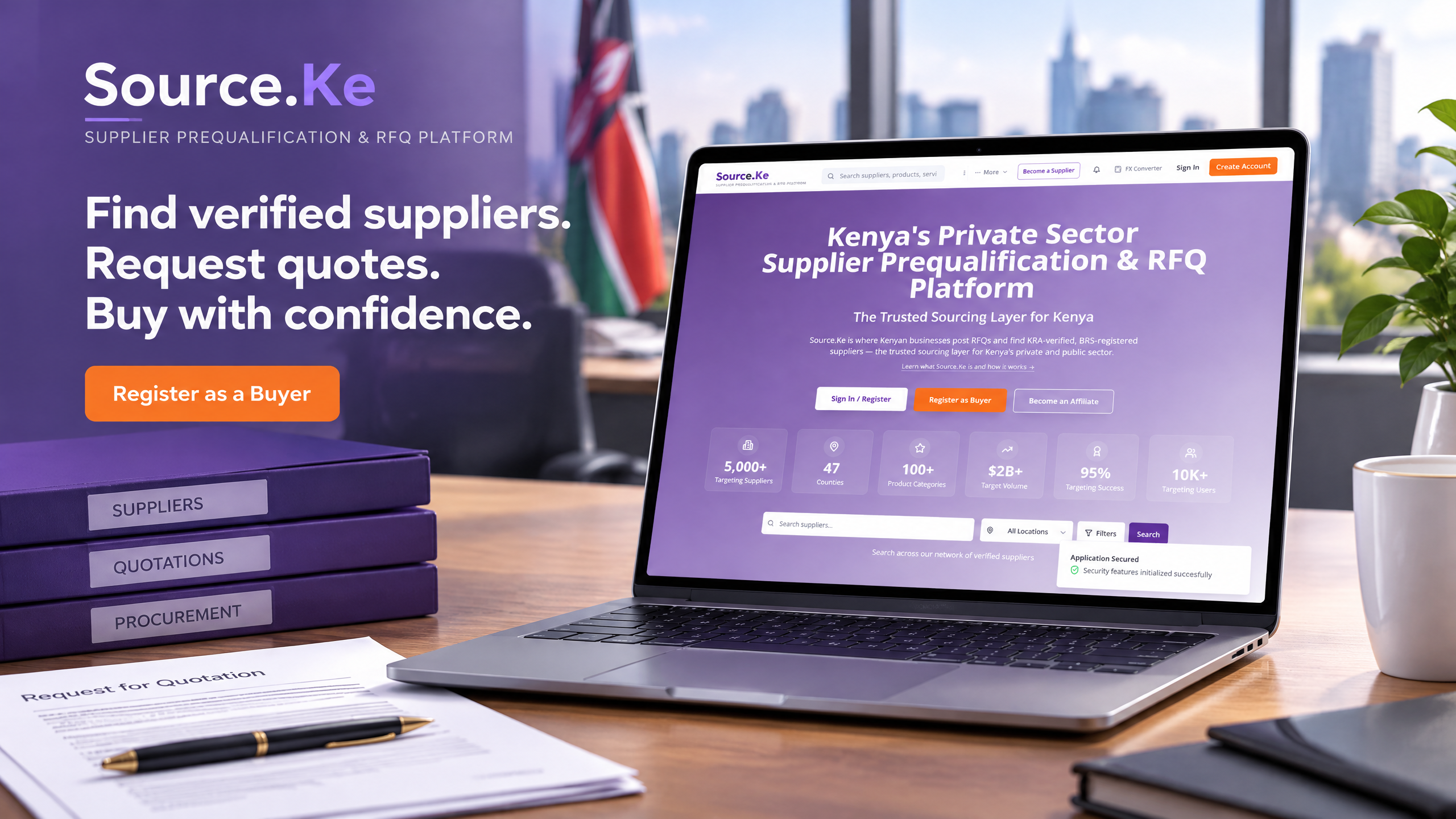

The best RFQ platforms in Kenya let a buyer describe what they need, send that request to several suppliers at once, and compare quotations side by side. For private-sector buyers and for suppliers chasing business outside government tenders, a good request-for-quotation tool saves days of phone calls and WhatsApp screenshots. This guide compares six ways to run RFQs in Kenya in 2026.
Disclosure: Tenderzville operates Source.ke, which appears in this list. We rated every option on the same criteria and list the weaknesses of each, including ours.
What We Looked For in an RFQ Platform in Kenya
- Supplier matching: does the request reach relevant suppliers, or do you blast everyone?
- Comparable responses: are quotations structured so you can compare them fairly?
- Supplier data quality: are profiles complete and kept current?
- Private-sector fit: does it work for companies, not only public entities?
- Cost and effort: what does it take to start?
New to the process? Start with our guides on how to respond to an RFQ in Kenya and RFQ vs RFP in Kenya.
1. Source.ke: RFQ Platforms in Kenya for Private-Sector Sourcing in Kenya
Source.ke describes itself as Kenya’s private-sector supplier prequalification and RFQ platform, and that focus is why it ranks first for this use case. Buyers and suppliers sit on the same system, so a request, the responses and the supplier’s compliance record live together.
Key features:
- RFQs and live auctions. Suppliers see Open RFQs and Live Auctions directly on their dashboard.
- Matching driven by data quality. The Data Freshness Score, out of 100, influences search ranking and RFQ matches, so suppliers who keep their profiles current surface first.
- Payment terms and Incoterms on the profile. Credit, bank, crypto, cash or cheque, plus Incoterms such as FCA, CPT and CIP, are visible before you request a quote.
- Compliance checklist. Tier 1 documents include business registration, KRA PIN, Tax Compliance Certificate and CR12/BOI.
- Buyer references and prequalification sit in the supplier dashboard.
- Many roles in one place. Suppliers, buyers, transporters, warehouse providers, lenders and more can all join, which helps when one RFQ needs logistics as well as goods.
Limitations: Source.ke is a marketplace only. Users remain responsible for their own due diligence and transactions, and the platform does not guarantee delivery or handle logistics liability. Supplier depth varies by category.
2. eGP Kenya: Best for Public-Sector Quotations
For anything involving a public entity, the official portal at egpkenya.go.ke is where requests for quotations and tenders now live, since eGP became mandatory on 1 July 2026.
Strengths: Legal standing and a single official record. If you want government business, you have to be here.
Weaknesses: It is built for procuring entities, not for general private buying. Companies looking for a flexible supplier search will not find it a substitute for a marketplace. Read our eGP registration guide to get set up.
3. Enterprise Procurement Suites: Best for Large Corporates
Large corporations often run supplier portals from global procurement software vendors, with RFQ, auction and contract modules. Suppliers register on the buyer’s portal and respond there. The supplier manual we reviewed for this guide, for example, describes the typical modules: RFx responses, auctions, contracts and supplier profiles with assessments and scorecards.
Strengths: Deep controls, audit trails and approval workflows.
Weaknesses: They are expensive and each buyer has its own portal, so a supplier juggles several logins. They rarely help a buyer discover new suppliers outside their own list.
4. Email and Spreadsheets: Best for One-Off Purchases
Many Kenyan SMEs still run RFQs by email: send a specification to three suppliers, paste prices into a spreadsheet, choose the cheapest.
Strengths: Free and familiar.
Weaknesses: No audit trail, inconsistent specifications, and no structured way to compare lead times or payment terms. Risk grows fast once spend grows.
5. WhatsApp and Phone Quotes: Best for Speed
Voice notes and WhatsApp catalogues dominate informal trade in Kenya. For urgent, low-value purchases they are hard to beat.
Strengths: Immediate.
Weaknesses: Quotes are scattered across chats, specs get lost, and there is no record you can show a finance team or auditor later.
6. General Online Marketplaces: Best for Standard Consumer-Grade Items
Consumer marketplaces work for office supplies and commodity goods where specification does not matter much.
Strengths: Instant price comparison.
Weaknesses: No RFQ workflow, no supplier compliance data, and poor fit for bulk, custom or credit-based B2B orders.
Comparison Table
| Option | Private-sector fit | Supplier compliance data | Structured RFQ | Cost to start |
|---|---|---|---|---|
| Source.ke | High | Checklist and profile data | Yes | Free plan available |
| eGP | Low (public only) | Official registration | Yes (tender-based) | Registration |
| Enterprise suites | High (per buyer) | Depends on buyer | Yes | High |
| Email and spreadsheets | Medium | None | Manual | Free |
| WhatsApp and phone | Medium | None | No | Free |
| General marketplaces | Low | None | No | Free |
How to Write an RFQ That Gets Useful Quotes
The platform matters, but the request matters more. Whatever tool you choose:
- Describe the item precisely. Size, grade, standard (for example KEBS), quantity and packaging.
- State delivery terms. Location, date and Incoterm where relevant.
- State payment terms. Say whether you expect credit, and for how long.
- Set a clear deadline. Suppliers answer faster when they know when you will decide.
- Ask for the same format from everyone. Unit price, total price, lead time and validity of the quote.
- Tell suppliers how you will choose. Lowest price, best value or a weighted score.
Mistakes Buyers and Suppliers Make With RFQs
Buyers
- Vague specifications. If suppliers quote for different things, prices cannot be compared and disputes follow.
- Choosing on price alone. The cheapest quote with a six-week lead time may cost more than a slightly pricier one that arrives on time.
- Giving too little time. Good suppliers need time to source and price accurately.
- Never telling losing bidders. A short reply keeps good suppliers responsive next time.
Suppliers
- Replying late. Most RFQs have a deadline and a late response is ignored.
- Quoting without reading the specification. Wrong grade, size or delivery terms lose the order after you win it.
- Leaving out the details. Quote validity, lead time and payment terms belong in every response.
- Ignoring the profile. On a platform, an incomplete or out-of-date profile can keep you out of matches.
How to Choose Between These Options
The right tool depends on who you are buying from and how much is at stake.
- Buying for a private company with regular spend? Use a platform with structured RFQs and supplier profiles, so every request follows the same format and leaves a record.
- Selling to government? Work through eGP, and use a marketplace in parallel to find private buyers.
- Running a large corporate procurement function? A dedicated suite may justify its cost, but a marketplace can still help you discover new suppliers.
- Making a small, urgent purchase? A quick call or message is fine, as long as you write down what was agreed.
Whatever you choose, keep the quotations. If a supplier disputes the price or specification later, a saved written quote settles it, and if your finance team or an auditor asks why you chose a vendor, the comparison is your answer.
For suppliers, the same logic applies in reverse: keep your profile complete, reply before the deadline and quote every item in the format the buyer asked for. Buyers remember the suppliers who make comparison easy.
Frequently Asked Questions
What is an RFQ in Kenya?
A request for quotation is a formal request asking suppliers to price specific goods or services. It is typically used when requirements are clear and price and delivery are the main differences between bids.
Which is the best RFQ platform in Kenya for private companies?
For private-sector sourcing, Source.ke is built specifically for RFQs and supplier prequalification. For public-sector work, the official eGP portal is required.
Can small suppliers respond to RFQs online?
Yes. On Source.ke, suppliers create a free account, complete their profile and see open RFQs from their dashboard.
How many suppliers should I send an RFQ to?
Three to five is usual. Fewer limits competition; more creates evaluation work without much extra value.
The Bottom Line
If you buy for a private business and want RFQs, supplier data and compliance documents in one place, Source.ke is the most focused option. If you want government work, eGP is non-negotiable. Spreadsheets and WhatsApp still have a place for small, urgent purchases, but they stop scaling the moment your spend, or your auditors, grow.
Ready to send your first RFQ? Create your Source.ke account and describe what you need.
Want more Kenyan procurement guides in your Google results? Add Tenderzville as a preferred source: