
Affiliate marketing in Kenya lets you earn a commission by recommending a product or service through your own tracking link, and in 2026 the best-paid route is no longer retail: it is referring businesses to B2B platforms that solve a real problem. If you want to earn through M-Pesa without a shop, stock or office, this guide shows how it works, what each programme pays, how to start with a smartphone, and how to handle payouts and tax.
Disclosure: Source.ke is built by Tenderzville, the publisher of this site. We show its numbers first because we can show them exactly, and we compare it with other programmes in the same table so you can judge for yourself.
Earn with the Source.ke Affiliate Programme — Free to Join
Refer suppliers who subscribe to a paid Source.ke plan and get paid to your M-Pesa. Here is exactly what one referral earns you:
| Supplier plan | Plan price | Your commission | You earn |
|---|---|---|---|
| Standard | KSh 2,500/yr | 8% | KSh 200 |
| Premium | KSh 4,000/yr | 10% | KSh 400 |
| Featured | KSh 10,000/yr | 30% | KSh 3,000 |
How Does Affiliate Marketing Work in Kenya? The 5 Steps
In practice, affiliate marketing in Kenya works like this: you share a unique link to a company’s product, and when someone buys or subscribes through your link, the company pays you a commission, usually straight to your M-Pesa. Genuine programmes are free to join, and you do not need a website, stock or capital.
- You join a programme. Sign up free with a company that pays affiliates, such as Source.ke, Jumia KOL or Host Africa.
- You get a unique tracking link. The link identifies you as the person who sent the customer.
- You share it. Use WhatsApp Status, TikTok, Facebook groups, LinkedIn or a blog post.
- Someone acts through your link. A tracking cookie remembers that you referred them. Source.ke’s tracking window is 30 days.
- You get paid. Once the sale is confirmed, your commission is paid out, on Source.ke to M-Pesa.
Worked example: you refer a Nairobi supplier who takes the Source.ke Featured plan at KSh 10,000 a year. At a 30% commission, you earn KSh 3,000 for that one referral.
There are two common ways to be paid. With pay-per-sale, you earn when the customer buys or subscribes; Source.ke, Jumia and Amazon work this way. With pay-per-lead, you earn when someone signs up or fills in a form, even without buying.
How to Start Affiliate Marketing in Kenya as a Beginner
To start, pick one audience you can reach, join one free programme, share your link inside useful content, and set up M-Pesa to receive payouts. You can begin today with only a smartphone.
- Pick who you can reach. Think of your WhatsApp contacts, business owners you know, students or job seekers. Your existing audience, however small, is your starting asset.
- Join one free programme. Never pay to register. A good first choice is Source.ke, which pays 8% to 30% commission on supplier subscriptions, direct to M-Pesa.
- Learn what you are promoting. For Source.ke, that means a business profile, RFQ (request for quotation) alerts and better search visibility for businesses that want tenders.
- Share value first, link second. Post tips on winning tenders or getting listed, then put your link in the caption or bio. Aim for 3 to 5 posts a week on the platform where your audience already is.
- Track and withdraw. Source.ke payouts go to M-Pesa once you reach the KSh 2,500 minimum.
- Keep records. Log every payout so you can declare it when you file your KRA returns.
Income usually takes a few months of steady posting to build, so do not quit after a month.
The State of Affiliate Marketing in Kenya in 2026
Most beginners start with retail links such as electronics or fashion, where commissions are small and the market is crowded. Retail programmes pay a few percent per sale, so one sale often earns less than the mobile data you spent to promote it.
The B2B route is different. Businesses in Nairobi, Mombasa and across the 47 counties want visibility with buyers, and a subscription they renew every year pays far more per referral than a one-off retail sale. The trade-off is honest to state: you need to talk to people who run a business, and each referral takes more trust than a retail link.
Work is also moving toward informal, phone-based income. The government said Kenya created about 822,100 jobs in 2025, and more than 87% of that growth came from the informal sector, citing the KNBS 2026 Economic Survey, as reported by The Standard in May 2026.
The rails for getting paid are already in place. The Communications Authority of Kenya counted 84.1 million mobile subscriptions and 53.4 million active mobile money subscriptions in the third quarter of 2025/26 (Telecom Review Africa). These are subscriptions, not unique people, because many Kenyans hold more than one SIM. Safaricom reported 46.4 billion M-Pesa transactions worth KSh 41.68 trillion in the year to March 2026 (Tech-ish).
A single WhatsApp Status, TikTok video or blog post can keep sending people to your link for weeks after you post it, but the income is not guaranteed, and it depends on your audience and effort.
Top Affiliate Programmes in Kenya, Ranked by Earning Potential
Programmes for affiliate marketing in Kenya differ widely in commission, cookie length and payout method, so match one to the audience you already have.
#1: Source.ke by Tenderzville (Best for B2B Referrals)
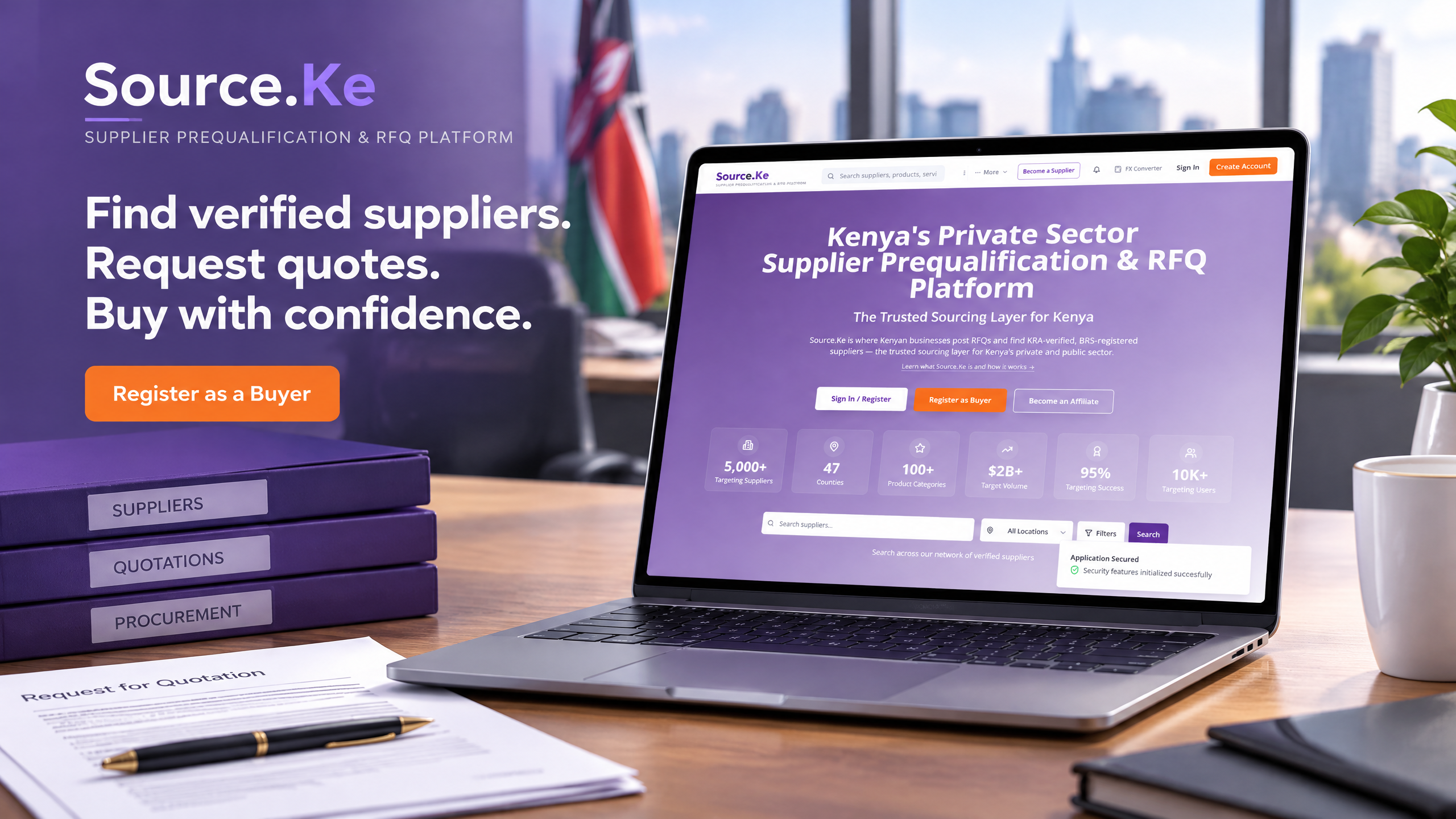
Source.ke is a B2B supplier directory and RFQ platform run by Tenderzville, alongside TenderPro Alerts, SokoConnect and Supply Chain Coded. You can see the full set on our supply chain apps page. When you refer a supplier business that subscribes to a paid plan, you earn commission to your M-Pesa.
- The market is broad: manufacturers, wholesalers, service providers and SMEs that want to be found by buyers.
- Commissions rise with the plan, up to 30% on the Featured plan.
- Payouts go to M-Pesa, so there is no Payoneer, bank transfer or currency conversion.
- B2B referrals can convert quickly because a business owner makes the buying decision alone.
What each plan gives a supplier (the reason they upgrade):
- Standard (KSh 2,500/yr): up to 5 products or services, 1 catalogue PDF, enhanced search ranking and 20 RFQ notifications a month.
- Premium (KSh 4,000/yr): up to 10 products, 3 PDFs, priority search placement, an analytics dashboard and unlimited RFQ access.
- Featured (KSh 10,000/yr): everything in Premium plus featured supplier placement, homepage visibility, category featured placement and priority in all searches.
A useful detail for planning: with a KSh 2,500 minimum payout, you need about 13 Standard referrals (KSh 200 each) or 7 Premium referrals (KSh 400 each) to reach it, but a single Featured referral (KSh 3,000) clears it on its own. Check the current threshold in your affiliate dashboard.
#2: KLM Affiliate Programme
KLM Royal Dutch Airlines runs a travel programme open to blogs, apps and comparison sites. You can join the KLM affiliate programme here. Based on its listed terms, medium-haul flights pay 1% and long-haul 1.5% of revenue, with a 30-day cookie. It suits travel bloggers, but rates are low per sale, so check current terms before you commit.
#3: Jumia KOL (Easiest for Beginners)
Jumia’s Key Opinion Leader programme is the simplest start for people with a social following or a WhatsApp group. Commissions range from 3% to 11% depending on category. The downside is a short cookie of about 7 days and low-priced items, so earnings per sale stay small. Check Jumia’s programme page for the current payout method and minimum.
#4: Host Africa (Recurring Tech Commissions)
Host Africa is a Kenyan web hosting brand with recurring commissions, so you keep earning while the customer stays. Rates, cookie length and payout method change, so read Host Africa’s affiliate page for current terms. It fits tech bloggers, developers and digital marketing consultants.
#5: Amazon Associates (The Global Option)
Amazon pays 1% to 10% depending on category. The challenge for Kenyans is withdrawal, because Amazon does not pay to M-Pesa directly. The Payoneer route is explained in the next section.
Programme comparison
| Programme | Commission | Payout | Best for | Cookie |
| Source.ke (Standard) | 8% | M-Pesa | B2B suppliers | 30 days |
| Source.ke (Premium) | 10% | M-Pesa | B2B suppliers | 30 days |
| Source.ke (Featured) | 30% | M-Pesa | B2B suppliers | 30 days |
| Jumia KOL | 3–11% | Check current terms | Beginners | 7 days |
| KLM Affiliate | 1–1.5% | Bank | Travel bloggers | 30 days |
| Host Africa | Varies (recurring) | Check current terms | Tech creators | Varies |
| Amazon Associates | 1–10% | Payoneer, then bank | Global audience | 24 hours |
Terms for programmes other than Source.ke can change. Confirm them on each programme’s own page before you promote.
How to Get Paid: M-Pesa and the Payoneer Bridge
Getting paid is the part of affiliate marketing in Kenya where many beginners stall, so set it up before you start posting.
Source.ke: direct to M-Pesa
Source.ke pays to your Safaricom M-Pesa number. Once your balance reaches the minimum threshold of KSh 2,500, request a withdrawal in the affiliate dashboard. Payouts are based on eligible cash subscriptions and arrive within 1 to 3 business days. Make sure the name on your affiliate account matches your M-Pesa registered name, so your payout is not flagged.
Amazon and other foreign programmes: the Payoneer bridge
- Create a free Payoneer account at payoneer.com with your Kenyan ID and phone number.
- Link Payoneer to Amazon Associates in your Amazon payment settings.
- Withdraw to your Kenyan bank (Withdraw, then To Bank Account), then send the money on to M-Pesa from your bank app. Payoneer does not pay directly to M-Pesa.
- Expect fees. Payoneer charges roughly 2% on USD to KES conversion plus a small flat withdrawal fee, and your bank may add charges. Check current pricing before you withdraw.
Wise is a popular alternative for receiving foreign payments. Compare current fees and withdrawal options before choosing.
Tax and Disclosure: Stay Legitimate
Commissions from affiliate marketing in Kenya are generally taxable income. Keep a digital log of every payout, and when you file on KRA iTax, confirm with KRA or a tax adviser how to declare it, for example under other income. Foreign platforms may be caught by the Significant Economic Presence tax, but that applies to them, not to you as an affiliate.
Always include an affiliate disclosure near your links, such as: “I may earn a commission if you sign up through links on this page.” It protects your audience’s trust and is expected by most programmes.
How to Promote Source.ke Without a Website
You do not need a website to earn from affiliate marketing in Kenya. Many Kenyans go online mainly on their phones, and social platforms are where many buying decisions start.
WhatsApp (the number one channel)
- Status: post tips and comparisons, then add your link in the caption. Views often peak around 7 to 9 AM and 7 to 9 PM.
- Groups: join business, procurement and SME groups and give value for 2 to 3 weeks before sharing any link. Spam gets you removed.
TikTok and Instagram Reels
- Post 30 to 60 second “How to” or “Did you know?” videos about tenders, RFQs and getting found by buyers.
- Put your link in your bio and post 3 to 5 times a week.
Facebook groups and LinkedIn
- Answer questions in groups such as Nairobi business networks and tender and procurement groups. Keep your link in your profile or a pinned post, not in every comment.
- On LinkedIn, share short posts on how visibility with buyers leads to more quotes and contracts. That speaks directly to the businesses who buy Featured plans.
Content that gives your link a reason to be clicked
Link to real, useful guides instead of a bare sales message. These pages help a business owner decide whether Source.ke is for them:
- Show the data: our analysis of AGPO contracts in Kenya explains who wins and why.
- Teach the process: how to respond to an RFQ in Kenya and how to register for AGPO.
- Warn about the deadline: how to register as a supplier before eGP locks you out.
- Send people to the Tenderzville hub to see every tool in one place.
An illustration, not a promise: if you built a 400-person WhatsApp Status audience of business owners and referred just 10 Featured subscribers in a month, the arithmetic is 10 x KSh 3,000 = KSh 30,000. Most affiliates refer far fewer, and results depend on your audience, your effort and the time you give it.
Affiliate Marketing in Kenya and Remote Work
- Zero capital: no inventory and no upfront investment. Real programmes are free to join.
- Work from anywhere: promote from Nairobi, Mombasa, Kisumu or a rural county, because your M-Pesa number is the only address that matters.
- Skills you can reuse: SEO, content creation and social media are skills you can later offer as a freelancer or in a marketing job.
Source.ke vs Retail Programmes
Here is how Source.ke compares with retail options for affiliate marketing in Kenya.
| Feature | Source.ke | Jumia and other retail |
| Commission | Up to 30% | 3–11% (varies by category) |
| Who you promote to | Business owners (B2B) | General consumers (B2C) |
| What the customer gets | Supplier listing, RFQ alerts, search visibility | A product |
| Repeat potential | Annual renewals | Mostly one-off purchases |
Learn more about the platform in our guide to B2B sourcing in Kenya.

Common Mistakes to Avoid
- Paying to join: if a programme asks you to pay KSh 500, KSh 2,000 or any amount to register as an affiliate, treat it as a red flag. Source.ke, Jumia, KLM and Amazon are free to join.
- Chasing low-commission items: do not spend KSh 500 on data and hours of effort to earn KSh 20. Favour higher-value referrals, such as Source.ke Premium and Featured plans, hosting or flights.
- Ignoring audience fit: Amazon products pitched to a group chat that rarely buys online is wasted effort. Match the programme to what your audience actually buys.
- Over-promoting to friends and family: it burns trust fast. Give value first.
- Giving up after 30 days: affiliate marketing in Kenya compounds slowly. Income usually takes a few months of steady effort.
Frequently Asked Questions
How does affiliate marketing work in Kenya?
You join a free programme, get a unique link, share it, and earn a commission when someone buys or subscribes through it. Source.ke pays 8% to 30% of the supplier plan price to your M-Pesa.
How do I start affiliate marketing in Kenya with no money?
Join a free programme like Source.ke, share your link on WhatsApp Status, TikTok or Facebook groups, and post useful content consistently. You need no website and no capital.
Is the Source.ke affiliate programme free to join?
Yes. You can register at no cost on Source.ke.
Can I promote to businesses outside Nairobi?
Yes. Source.ke is for suppliers across all 47 counties.
How often are affiliate payouts processed?
Payouts are based on eligible cash subscriptions and are processed to M-Pesa once you reach the KSh 2,500 minimum withdrawal.
Ready to Earn? Join Source.ke Free Today
Earn up to KSh 3,000 per Featured referral, paid to your M-Pesa. No joining fee, no website needed.
Conclusion: Start Your Journey Today
Affiliate marketing in Kenya is no longer only a small side hustle. By focusing on higher-value B2B referrals like Source.ke, getting paid through M-Pesa and keeping your tax records in order, you give yourself a realistic chance to build income over time. Your next three steps:
- Sign up as an affiliate (free) on the Source.ke portal.
- Set up Payoneer only if you also plan to promote global brands like Amazon (optional).
- Write your first value-first post, for example on how a business can get found by buyers, and link one of our guides above.