
The best procurement software platforms in Kenya help teams control purchasing, suppliers, approvals, and spend without slowing the business. Procurement teams in Kenya have very different requirements. A multinational may need source-to-pay governance, ERP integration and supplier-network collaboration, while a growing business may simply need purchase requests, approvals, purchase orders, inventory and bills in one place. The right procurement software is therefore less about choosing the biggest brand and more about matching capability, implementation capacity, supplier adoption and total cost to the organisation.
This editorial list ranks 10 best procurement software platforms in Kenya for private-sector organisations, NGOs, schools, manufacturers, distributors and complex enterprises. The ranking is editorial, not an official certification or endorsement. It considers product breadth, usefulness for common Kenyan operating models, evidence of Kenya access or implementation, transparency of the available information, and likely fit for different organisation sizes. Availability in Kenya does not by itself prove local implementation, KRA or eTIMS compliance, tax treatment, data residency, regulatory approval, public-procurement eligibility or Government of Kenya endorsement. Buyers should validate those points in a Kenya-specific demonstration and contract.
Quick comparison: Best procurement software in Kenya
| Editorial rank | Platform | Best for | Kenya relevance signal | Pricing note |
|---|---|---|---|---|
| 1 | Odoo Purchase | Best overall for growing businesses and integrated ERP procurement | Odoo’s Kenya directory lists 31 partners, including Nairobi and Mombasa providers | Free one-app plan; paid plans are per user; local implementation and taxes extra |
| 2 | ERPNext | Best for open-source flexibility | Frappe lists Nairobi-based Navari and Upande implementation partners | Software is free and open source; hosting and implementation cost extra |
| 3 | Zoho Procurement / Inventory / Books | Best for SMEs wanting procurement, inventory and accounting | Zoho Books has a Kenya edition/page with eTIMS-oriented workflows and M-PESA evidence | Public prices are global/US-page figures; confirm Kenya edition, taxes and Procurement pricing |
| 4 | Precoro | Best for multi-branch internal purchasing | Vendor-published case studies cover I&M Bank Kenya and Crop Nutrition Laboratory Services | Core from US$499/month and Automation from US$999/month, billed annually; quote required |
| 5 | SAP Ariba / SAP Business Network | Best for large enterprises and complex supplier networks | SAP documents a KETRACO implementation and lists SAP East Africa in Nairobi | Quote-based; supplier network accounts and transaction fees vary |
| 6 | Microsoft Dynamics 365 Supply Chain Management | Best for ERP-led supply-chain procurement | Microsoft Marketplace lists a third-party KRA eTIMS integration; partner capability must be checked | US page lists USD 210/user/month and Premium at USD 300/user/month; not a Kenya quote |
| 7 | Oracle Fusion Cloud Procurement | Best for Oracle Fusion ERP environments | Africa-region Oracle services and partners are available, but Kenya-specific proof was not verified | Oracle price list is in USD; standard cloud term is stated as three years |
| 8 | SYSPRO ERP Procurement | Best for manufacturing and distribution | SYSPRO has a Nairobi office and Kenya/Africa partner listings | Quote-based; no public Kenya price found |
| 9 | Coupa | Best for global spend control and mature P2P governance | Coupa’s sales form accepts Kenya and its partner ecosystem supports global delivery | Contact sales; buyer pricing is not publicly posted on reviewed pages |
| 10 | GEP SMART | Best for global source-to-pay breadth | GEP lists African operations, but not a Kenya office or named Kenya customer in the reviewed material | Request a proposal; no public Kenya tariff found |
What to check before choosing procurement software in Kenya
For organisations comparing procurement software platforms in Kenya, the most important question is not which brand is largest; it is which system matches local operations, internal controls, supplier participation, and implementation capacity.
Before reviewing the individual products, separate three questions that are often mixed together:
- What process must the software run? Internal requisitions, sourcing events, supplier onboarding, purchase orders, goods receiving, invoice matching, payments, contracts, budgets and spend analysis are different capabilities.
- What local requirements must it support? Confirm currency, tax and e-invoicing needs, audit records, user permissions, approvals, payment workflows, data protection, integrations and reporting with your accountant, adviser or implementation partner.
- Who will implement and operate it? A global product with a strong Kenyan partner can be a better choice than a locally available product that lacks the required controls. Ask for named consultants, references, support hours, escalation paths, migration scope and post-go-live ownership.
Important: The order above is a practical editorial shortlist, not a statement that one product is objectively best for every Kenyan buyer. A small business may reasonably choose #3 over #5, while a large SAP customer may put SAP Ariba first.
HOWEVER...It is not a software issue, its a trust issue!
Find. Verify. Source.
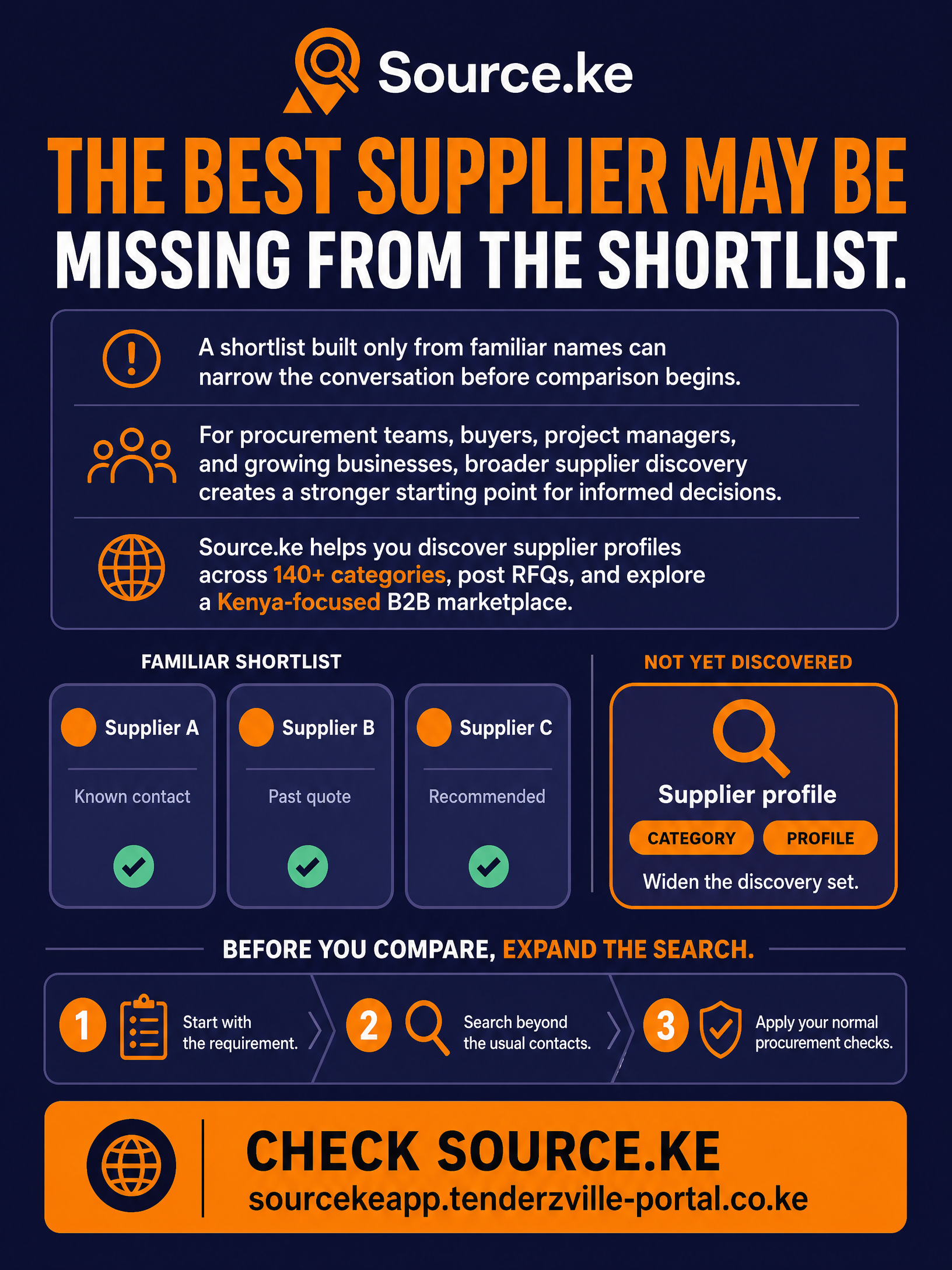
Source.ke helps buyers discover suppliers across Kenya while giving businesses a professional digital presence that can be found when opportunities arise.
Whether you’re sourcing products, services, logistics, equipment, or specialized expertise, Source.ke is building a future where procurement decisions are driven by visibility, credibility, and capability.
Because opportunity should never depend on who knows whom. It should depend on who can deliver.
1. Odoo Purchase — Best overall for growing Kenyan businesses
Among procurement software platforms in Kenya, Odoo is a practical starting point for growing organisations that want ERP breadth without an enterprise-only buying process.
Odoo Purchase is our editorial #1 for organisations that want purchasing connected to inventory, accounting, sales and the rest of an ERP. It is particularly compelling for SMEs, multi-location businesses and multi-company groups that would rather avoid stitching together a standalone purchase-order tool, inventory system and accounting package.
Why it ranks highly in Kenya
Odoo provides unusually clear evidence of local delivery access: its Kenya partner directory lists 31 partners, including Advance Insight Kenya in Nairobi and Innovus Tech Consultants in Mombasa. Those listings demonstrate that a Kenyan organisation can investigate local implementation, customisation, integration, training and support. They do not, on their own, prove KRA compliance, a government contract or suitability for every public-procurement workflow.
The product itself supports RFQs, purchase tenders, vendor pricelists, blanket orders, replenishment rules and three-way matching between a purchase order, receipt and vendor bill. Confirmed purchase orders can create receipts, while purchasing connects to inventory and accounting. Multi-company functionality can also help groups operating more than one legal entity or branch.
Key features
- Create and send RFQs to vendors by email or printable PDF.
- Run purchase tenders, collect alternative quotations and compare supplier offers.
- Use reordering and procurement rules to automate replenishment from configured stock conditions.
- Manage blanket orders and recurring purchases at negotiated prices.
- Connect purchase orders, receipts and vendor bills through inventory and accounting workflows.
- Track vendor lead times, references, units of measure, purchase dashboards and supplier performance.
- Support multi-company operations and intercompany order mirroring where configured.
See the Odoo Purchase overview, Purchase features and RFQ documentation for the current product description.
Limitations and pricing
Odoo Purchase is an ERP module, not a specialist Kenyan public-tender portal. The global product pages do not prove Kenya-specific tax, e-invoicing, language or public-procurement functionality. Implementation, configuration, migration, training, integrations and custom development may require a partner.
Odoo’s pricing page shows a free one-application plan with unlimited users and paid Standard and Custom plans priced per user. The displayed currency and amounts depend on the visitor’s locale and are not a Kenya quote. Custom can add options such as Odoo.sh or self-hosting, Studio, multi-company and external API access. Taxes, specialist services, custom-code maintenance and optional in-app credits may add cost.
Choose Odoo Purchase if: you want a flexible, integrated ERP and can involve a capable Kenyan partner. Look elsewhere first if: you only need a simple standalone tender notice board or government bid-submission system.
2. ERPNext — Best for open-source flexibility
For buyers shortlisting procurement software platforms in Kenya, ERPNext stands out when open-source control and local customisation matter.
ERPNext is our editorial #2 and the strongest choice in this list for buyers who value open-source control, extensibility and the ability to connect purchasing with inventory, accounting, manufacturing and other ERP processes. It can suit Kenyan SMEs and mid-sized companies with an internal technical team or a trusted local implementation partner.
Why it ranks highly in Kenya
ERPNext’s buying workflow can start with a material request, move through an RFQ and supplier quotation, and end in a purchase order, receipt, invoice and payment. Frappe’s official partner directory lists Navari in Nairobi, which describes ERPNext implementation and customisation coverage in Kenya, East Africa and Africa, and Upande in Nairobi, which states that it has implemented ERPNext since 2012. This is evidence of local implementation availability, not proof of a particular Kenyan customer, tax certification or Government of Kenya integration.
The open-source model can be valuable where the buyer wants to inspect, extend or self-host the software. It can also make the platform attractive for organisations that need custom workflows but want to avoid per-user licensing as the main cost driver.
Key features
- Initiate procurement through approved Material Requests.
- Send RFQs to suppliers, including through a Supplier Portal.
- Collect and compare Supplier Quotations, including line-by-line pricing analysis.
- Formalise approved buying through Purchase Orders.
- Receive goods against purchase orders, with delayed-receipt tracking, quality checks and put-away rules.
- Connect Purchase Invoices, accounts payable, payments, budgets, permissions, custom workflows and APIs.
- Use procurement reports and analytics with inventory and accounting visibility.
The ERPNext procurement guide, Purchase Order documentation and RFQ documentation describe the workflow in more detail.
Limitations and pricing
ERPNext is a broad ERP rather than a specialist public-tender platform. Frappe says implementation is handled by partners, so the quality of the chosen partner, scope definition and local support arrangement matter. Self-hosting requires technical capability; managed hosting reduces operational effort but introduces recurring hosting charges. The reviewed official material does not establish Kenya-specific tax compliance, data residency, certification or e-GP integration.
Frappe describes ERPNext as free and open source under AGPL-3.0. Hosting is still a cost: Frappe Cloud pricing shows starting plans, while implementation, migration, integration, training, localisation and support require separate budgeting. The published starting figures are hosting points, not a complete Kenya deployment quote.
Choose ERPNext if: open-source flexibility and control are important. Plan carefully if: your team cannot own technical administration or you need a ready-made statutory/public-procurement solution.
3. Zoho Procurement / Zoho Inventory and Zoho Books — Best for SMEs
Zoho is one of the more approachable procurement software platforms in Kenya for smaller teams that need purchasing, inventory, and accounting together.
Zoho’s procurement, inventory and accounting products make our editorial #3 for Kenyan SMEs and growing distributors, retailers and service businesses. Zoho Procurement offers the deeper source-to-pay layer; Zoho Inventory and Zoho Books are often the more practical combination when the immediate need is purchase orders, stock, vendor bills and accounting.
Why it ranks highly in Kenya
Zoho has the strongest local evidence in Zoho Books. Its Kenya Books page advertises eTIMS-oriented invoicing and VAT workflows, KRA item and bill mapping, KES presentation and related local accounting capabilities. Zoho’s official M-PESA integration article documents a connection for Zoho Books and Inventory. These are useful signals, but buyers should confirm the current scope and applicability with Zoho or an experienced adviser before relying on them for statutory reporting.
Zoho Procurement supports purchase requests, configurable approvals, RFx/RFQ sourcing, supplier self-service, purchase orders, purchase receives and invoice matching. Zoho Inventory adds purchasing, multi-warehouse stock, reorder alerts, barcodes, batches and serial numbers. Zoho Books connects purchasing to bills and payments. Together they can provide an approachable path from purchasing to finance without the implementation weight of a large ERP.
Key features
- Create purchase requests with hierarchical, parallel or ad hoc approvals.
- Use catalogs, policy controls and out-of-policy alerts.
- Run RFx/RFQ processes, compare bids and shortlist vendors.
- Give suppliers self-service access for bids, POs, invoices and payment tracking where configured.
- Convert approved requests or RFQs to purchase orders, including blanket POs.
- Record partial or complete receipts and support PO, receipt and invoice matching.
- Manage multi-warehouse inventory, reorder alerts, barcode/RFID and batch/serial tracking in Zoho Inventory.
- Connect purchase orders to bills, bill payments, currencies and accounting in Zoho Books.
Explore the Zoho Procurement product, Zoho Inventory and Zoho Inventory purchase-order documentation.
Limitations and pricing
Zoho Procurement is presented as a global product in the reviewed sources. There is no verified Kenya-specific edition, Kenyan Procurement customer reference, local office or government-portal integration in the evidence used for this article. Zoho Inventory’s editions guidance says country-dependent handling applies and that countries outside listed editions use the Global edition; confirm Kenya-specific Inventory tax behaviour before purchase.
The official public pricing reviewed is in US dollars and excludes local taxes. Zoho Books pricing shows a free plan and paid plans from US$20/month monthly or US$15/month on annual billing for Standard, with Professional shown at US$50/month monthly or US$40/month annually. Zoho Inventory lists a free plan and annual-billing prices from US$29/month for Standard. Zoho Procurement’s reviewed page emphasises signup or demo rather than a comparable Kenya price. Confirm currency, taxes, users, locations, order limits, add-ons and Procurement pricing directly with Zoho.
Choose Zoho if: you are an SME that wants a familiar, modular business stack. Do not assume: that a Kenya Books edition automatically makes every Zoho product Kenya-localised or public-procurement compliant.
4. Precoro — Best for multi-branch internal purchasing
Precoro deserves attention in a procurement software platforms in Kenya comparison because its vendor-published Kenyan case studies show practical multi-branch use.
Precoro is our editorial #4 for mid-sized organisations, NGOs and multi-branch businesses that need structured internal purchasing, approval controls and accounts-payable automation without adopting a full ERP. Its Kenya relevance is stronger than many global-only products because Precoro publishes two Kenya customer case studies.
Why it ranks highly in Kenya
Precoro’s case study on I&M Bank reports use in Kenya since August 2021, 220 users, more than 50 branches and an average of at least 150 purchase orders per month. A second Crop Nutrition Laboratory Services (Cropnuts) case study describes a Kenyan deployment with 14 users and about 50 POs per month. These figures are vendor-published case-study claims, not independent validation, but they show that the platform has been used in Kenyan operating contexts.
The platform is focused on controlling the internal request-to-pay process. That makes it a useful fit for distributed teams that need consistent approvals, an audit trail, supplier collaboration and visibility across locations.
Key features
- Capture purchase requisitions through custom forms, warehouse requests and expense workflows.
- Route approvals automatically using department, location, spend limits and custom fields.
- Create POs from requisitions, RFPs or warehouse requests, including recurring, blanket and service POs.
- Run RFPs, onboard suppliers, compare bids side by side and convert winning bids into POs.
- Track receipts and invoices, with two-way and three-way matching, tolerance controls and duplicate-invoice detection.
- Manage budgets, spend, inventory, catalogs and PunchOuts.
- Use mobile workflows for requests, approvals, order tracking and PO dispatch.
- Connect to accounting and ERP products through listed integrations, API or SFTP.
See the Precoro product pages, integrations and mobile-app overview.
Limitations and pricing
The reviewed official material does not establish a Kenyan office, Kenya-specific tax or eTIMS integration, KES pricing, statutory certification or local government-portal connectivity. The case studies demonstrate usage, not regulatory approval. The mobile app requires an internet connection and does not provide every feature available on the web version.
Precoro’s pricing page lists Core from US$499/month and Automation from US$999/month, both billed annually; Enterprise is custom billed annually, and an AP Module is also listed from US$499/month annually. Package pricing is customisable and paid add-ons may be available. These are global vendor-listed starting points, not confirmed Kenya prices. Request a quote that covers VAT or other taxes, onboarding, integrations, user limits and add-ons.
Choose Precoro if: internal approvals and multi-branch visibility are more important than a full ERP. Do not choose it as: a replacement for Kenya’s public tender or government e-procurement platforms.
The Next Big Contract Could Come From One Conversation
Most SMEs spend years searching for opportunities.
The smartest businesses build relationships where opportunities are already flowing.
Kenya Supply Chain Network ((Facebook). Join procurement professionals, suppliers, contractors, distributors, and business owners discussing sourcing, supply chains, tenders, vendor management, and growth opportunities across Kenya.
Whether you buy, sell, distribute, manufacture, transport, or supply, this community was built for you

5. SAP Ariba / SAP Business Network — Best for enterprise
Large organisations evaluating procurement software platforms in Kenya may prefer SAP Ariba when supplier-network collaboration and SAP integration justify the investment.
SAP Ariba, now positioned within SAP Business Network and SAP Spend Management, is our editorial #5 and the strongest shortlist candidate for large Kenyan enterprises, multinationals and complex state corporations that need deep source-to-pay governance and SAP integration.
Why it ranks highly in Kenya
SAP provides documented Kenyan evidence through its KETRACO case study. SAP says the government-owned Kenya Electricity Transmission Company Limited implemented SAP Business Network in two phases, including Commerce Automation and Sourcing Suite modules for supplier lifecycle, contract management and sourcing. The stated outcomes include electronic purchase orders and invoices, centralised invoicing, supplier monitoring and large-tender handling.
This is an important Kenyan implementation reference, but it does not prove that every feature or configuration is locally compliant or suitable for every organisation. SAP also lists SAP East Africa Limited at a Nairobi address, and its partner directory can help buyers investigate current local expertise. Confirm support scope, integration capability, implementation resources, currencies, taxes and regulatory requirements during procurement.
Key features
- Guided buying, centralised catalogs, purchasing, invoicing, approvals and spend visibility across ERP systems.
- Source requests, RFx events, requirements collection and structured sourcing projects.
- AI-assisted event-content recommendations, supplier and bid matching, progress tracking, reminders, approvals and bid summaries, as described by SAP.
- Supplier discovery and collaboration through searchable SAP Business Network profiles and filters for industry, goods/services, certifications and ESG criteria.
- Bid comparison, split or single awards, scenario comparison and award optimisation.
- Exchange proposals, contracts, POs, invoices and payment-status information through the supplier network.
Product details are available on SAP procurement, SAP Ariba Sourcing features and SAP Business Network.
Limitations and pricing
SAP is broad and enterprise-oriented. A successful deployment can require process design, ERP integration, supplier onboarding, governance, training and change management; SAP’s Kenyan case describes a phased implementation and customer-success involvement. Do not infer Kenya tax, e-invoicing, public-procurement or language compliance from global feature claims.
SAP’s Ariba Sourcing pricing page shows price upon request, priced per user per year, with one- to five-year contract terms and auto-renewal. SAP Business Network supplier pricing lists standard supplier accounts as free, while enterprise accounts can involve subscription levels and transaction-volume fees. Obtain a Kenya-relevant quote covering licences, implementation, integration, training, support, taxes and supplier-network costs.
Choose SAP Ariba if: SAP integration, complex sourcing and network collaboration justify enterprise investment. Avoid treating it as: Kenya’s government e-GP or IFMIS infrastructure.
6. Microsoft Dynamics 365 Supply Chain Management — Best for ERP-led supply-chain procurement
Microsoft Dynamics 365 belongs on a procurement software platforms in Kenya shortlist when procurement is part of a wider supply-chain and finance transformation.
Microsoft Dynamics 365 Supply Chain Management (SCM) is our editorial #6 for midsize and large organisations that want procurement embedded in inventory, planning, warehousing, vendor performance and finance. It is especially relevant to manufacturers, distributors and operationally complex organisations already considering the Microsoft business application ecosystem.
Why it ranks in Kenya
Microsoft documents procurement and sourcing from identifying a need through procurement, receipt, invoicing and vendor payment in its procurement and sourcing overview. For Kenya, a Microsoft Marketplace listing for a third-party KRA eTIMS integration says it supports Dynamics 365 Supply Chain Management, including vendor bills, KRA PIN or regulatory details and audit logs.
That integration is from a Marketplace publisher, not evidence that all Kenya tax functionality is native to SCM or that Microsoft itself operates a Kenyan procurement edition. Microsoft directs buyers to its partner directory for assessment, implementation, customisation, training and support.
Key features
- Configure procurement policies and workflows from need identification to receipt, invoice and payment.
- Create purchase requisitions with catalogs, spending limits, budget-fund allocation and approvals.
- Issue RFQs to multiple suppliers, collect bids and support supplier selection.
- Use vendor catalogs and approved-vendor lists.
- Create POs from master planning, requisitions, purchase agreements or manual entry.
- Match product receipts and vendor invoices, record accounting distributions and support accounts-payable workflows.
- Analyse spend and vendor performance through procurement and finance reports.
The Dynamics 365 Supply Chain Management product page provides current positioning and links to pricing and capabilities.
Limitations and pricing
SCM is a broad Finance and Operations application, not a lightweight tendering tool. Implementation typically involves architecture, partner configuration, integrations, customisation, data migration, training and optimisation. The Kenya eTIMS capability cited here is a separate Marketplace integration; validate its publisher support, scope, updates and KRA requirements before relying on it.
Microsoft’s US pricing page currently lists Supply Chain Management at US$210 per user/month paid yearly and Premium at US$300 per user/month paid yearly. Microsoft says displayed prices are informational and can vary by currency, country and regional variant. Obtain a Kenya-specific quote and budget separately for partner implementation, integrations, support and taxes.
Choose Dynamics 365 SCM if: supply chain and ERP integration are central to the business. Choose a simpler product if: the need is only basic purchasing or tender posting.
7. Oracle Fusion Cloud Procurement — Best for Oracle Fusion ERP environments
Oracle Fusion Cloud Procurement is our editorial #7 for large and upper-mid-market organisations that already use, or intend to use, Oracle Fusion Cloud ERP. It offers the governance expected of an enterprise source-to-pay suite rather than a simple request-for-quotation application.
Kenya relevance and product fit
Oracle’s Africa procurement page and Africa ERP consulting page show regional positioning and implementation services. Oracle also maintains an Oracle PartnerNetwork through which Kenyan buyers can investigate implementation capability.
However, the reviewed official sources did not verify a Kenyan customer, Kenya office, Kenya-specific pricing, local tax treatment, e-procurement certification or named Kenya implementation partner for Fusion Procurement. That makes Oracle a strong global enterprise contender, but not a Kenya-localisation winner by default.
Key features
- Procure-to-pay workflows that apply negotiated pricing and procurement policies.
- Guided sourcing requests, collaboration, approvals, negotiation and AI-driven supplier recommendations.
- Contract authoring with templates, approvals, audit trails, e-signatures, searchable repositories and expiry alerts.
- Self-service procurement with catalogs, guided buying, approved suppliers and compliance workflows.
- Supplier onboarding, profiles, catalogs, orders, shipments, invoices, forecasts, qualification, scorecards and risk assessment.
- Sustainability reporting using supplier, item and invoice data to track impacts and emissions within Oracle Fusion Cloud ERP.
See Oracle’s Fusion Cloud Procurement overview and product documentation.
Limitations and pricing
This is an enterprise suite requiring configuration of users, roles, currencies, structures, controls, integrations, data and change management. Oracle’s public product pages direct prospects to a demo or sales conversation rather than a simple Kenya retail price. Buyers should confirm connectivity, security, data residency, local support, integrations and statutory requirements.
Oracle’s official Fusion Cloud global price list identifies Fusion Procurement Cloud Service, states prices are in US dollars and says the standard cloud-service subscription term is three years. It does not establish a Kenya price or universally applicable package. Request a quote with licence metrics, minimums, implementation, integrations and support.
Choose Oracle if: Fusion ERP is already your strategic platform. Rank it lower if: Kenya-local references, simple pricing or SME usability are your primary criteria.
8. SYSPRO ERP Procurement — Best for manufacturing and distribution
SYSPRO ERP Procurement is our editorial #8 for mid-market and larger manufacturers or distributors that want procurement embedded in a broader operational ERP. The product covers source-to-pay, supplier performance, receiving, inventory, landed cost and financial integration rather than functioning as a standalone tender marketplace.
Why it is relevant to Kenya
SYSPRO’s Kenya site states that it has a Nairobi office. Its Kenya partner listings include Inficore Limited, which describes SYSPRO consulting, integration, support and maintenance across Africa, and other Kenya/Africa partners. This supports local access and implementation investigation, but the reviewed sources do not prove a Kenyan customer reference, Kenya tax or e-invoicing compliance, public-sector certification or local pricing.
Key features
- End-to-end source-to-pay processes from strategic sourcing and requisition through PO, receipt and invoice matching.
- Supplier profiles, performance metrics, contract records and portal collaboration.
- Configurable approval levels, spending limits, budgets, capex tracking and user authority.
- RFQs sent to multiple suppliers, online responses, bid comparison and PO generation from winning quotes.
- Blanket POs, scheduled deliveries, call-offs, standing orders and supply agreements.
- Multiple currencies, multi-language documents, GRN-based matching, quality inspection and landed-cost tracking.
- Integration with accounts payable, inventory, general ledger and requirements planning.
Review SYSPRO procurement management and the business-process overview.
Limitations and pricing
SYSPRO is designed for manufacturers and distributors, so it may be too extensive for a small organisation seeking only simple purchasing or tender publication. The official product pages describe global capabilities and do not establish Kenya-specific tax, e-invoicing, public-procurement, data-residency or certification support.
No public Kenya or global list price was found in the reviewed sources. SYSPRO uses demo and contact-sales calls to action. Request a Kenya-specific quote covering licences or subscription, procurement scope, implementation, integrations, training, support, taxes and ongoing maintenance.
Choose SYSPRO if: operational ERP depth and manufacturing/distribution workflows matter. Consider another option if: you need transparent SME pricing or a government tender portal.
9. Coupa — Best for global spend control and mature P2P governance
Coupa is our editorial #9 and a useful global benchmark for large and mid-market organisations seeking guided buying, sourcing, supplier collaboration, contracting, budgets, invoicing and spend analytics in one cloud environment. It is private organisational procurement software, not a Kenyan government tender platform.
Kenya relevance and product fit
Coupa’s official contact form accepts Kenya as a country or region, and its Partner Xchange supports implementation and consulting partner discovery. Coupa’s reviewed office list shows a Dubai office under Africa and the Middle East but not a Kenya office. The reviewed evidence did not establish a Kenyan customer, local implementer, Kenya tax or e-invoicing integration, or public-procurement certification.
Key features
- AI-assisted guided intake and buying based on preferred, contracted products and services.
- Requisitions, POs, approvals, invoice validation and three-way matching.
- Integrations with major ERP systems including SAP, Oracle, NetSuite, Workday and Microsoft Dynamics.
- Spend dashboards by category, business unit, region or supplier.
- Supplier self-registration, information maintenance, PO sharing, e-invoicing and performance or risk visibility through the Coupa Supplier Portal.
- RFI, RFQ and RFP templates, bid collection, reverse auctions, optimisation and sourcing audit trails.
- Contract and budget management plus controls intended to identify duplicate invoices, split requisitions and suspicious activity.
See Coupa’s procurement product page, source-to-pay overview and sourcing page.
Limitations and pricing
Coupa deployments commonly take months, depending on scope and complexity. Its breadth and partner-led model can require substantial process design, integration and change management. Kenya readiness remains unverified in the official material reviewed, so do not infer local compliance from global marketing or from an Africa-region office.
Coupa does not publish a standard buyer subscription price on the reviewed product pages and directs prospects to sales or a demo. Any supplier-portal fees on separate Coupa Supplier pages should not be treated as the buyer’s platform price. Obtain a Kenya-specific quote covering modules, users or transactions, integrations, implementation, support and applicable taxes.
Choose Coupa if: you need mature enterprise spend controls and have implementation capacity. Rank it lower if: Kenya-local support, simple pricing or SME simplicity is decisive.
10. GEP SMART — Best for global source-to-pay breadth
GEP SMART is our editorial #10 for large private companies, regional groups and multinationals that want a unified source-to-pay suite covering strategic sourcing, contracts, supplier management, purchasing, invoicing, payment workflows, spend analysis and savings tracking. GEP says SMART is being consolidated under GEP Quantum Intelligence, while SMART remains supported; buyers should clarify the roadmap and commercial transition in the contract.
Kenya relevance and product fit
GEP’s global-presence page lists African offices or operations in Pretoria, Cairo, Addis Ababa and Lagos, but not Kenya. The reviewed official sources do not provide a named Kenyan customer, Kenya office, Kenya-specific implementation, local price, tax-compliance claim or Kenyan certification. GEP’s partner ecosystem supports global and regional delivery, so Kenyan buyers should ask directly about partner coverage, data hosting, language, ERP integration and local statutory requirements.
Key features
- Unified cloud-native source-to-pay platform with AI positioning.
- Lifecycle coverage from intake and sourcing through contract management, purchasing, invoicing and payment.
- RFx, auctions, bid analysis and award recommendations.
- Supplier records, onboarding, performance, collaboration and third-party risk monitoring.
- Spend analysis, category management and savings tracking.
- Integration with major ERP and finance systems; GEP states that the current platform has more than 1,000 out-of-the-box connectors and supports SAP, Oracle, JD Edwards, PeopleSoft and other systems.
Read GEP’s source-to-pay overview, product update and request-for-proposal page.
Limitations and pricing
GEP’s enterprise orientation may be heavier than necessary for a small Kenyan business. The reviewed material does not document a small-business edition, Kenya localisation or a standard local deployment. No public GEP SMART price was found; GEP directs prospects to request a business proposal. Treat pricing as quote-based and dependent on modules, users or spend, integrations, implementation and support.
Choose GEP SMART if: a large organisation wants a global source-to-pay benchmark and can fund enterprise implementation. Choose a different product if: transparent SME pricing or documented Kenyan delivery is more important.
Kenya e-GP and PPIP: official public-procurement portals, not general private software
A crucial distinction is whether you need internal procurement software or access to Kenya’s public-procurement infrastructure.
e-GP Kenya is the government’s electronic government-procurement system. Kenya’s National Treasury describes e-GP Kenya and the e-GP portal as the official environment for public entities and online procurement activities. The Treasury’s launch announcement provides additional government context.
PPIP, the Public Procurement Information Portal, is an official public-procurement information channel for publishing and accessing government tender and award information. Buyers and suppliers can consult the PPIP portal for public tender information.
These portals are not interchangeable with Odoo, ERPNext, Zoho, Precoro, SAP Ariba, Microsoft Dynamics, Oracle, SYSPRO, Coupa or GEP. The commercial products in this list can manage an organisation’s internal requisitions, sourcing, approvals, POs, invoices, suppliers and spend; they should not be presented as replacements for e-GP, PPIP, IFMIS or other statutory government systems. A private company may use procurement software internally and still need to follow the applicable official portal or tender process when participating in public procurement.
Likewise, the fact that a product has a Kenyan partner, Kenya case study, KRA-related add-on or Africa-region sales coverage does not mean that the product is approved by the Government of Kenya or legally sufficient for public procurement. Confirm obligations with the relevant Kenyan authority and professional advisers.
Buyer checklist: how to select procurement software in Kenya
Use the following checklist before signing a contract or starting a pilot.
1. Map the process, not just the feature list
Document the current process from request to approval, sourcing, purchase order, delivery, invoice and payment. Decide whether you need catalogues, RFQs, tenders, contracts, supplier onboarding, budgets, three-way matching, inventory, AP, spend analytics or all of them. A feature-rich ERP can be unnecessary if your real need is approval control and PO tracking.
2. Validate Kenya-specific requirements
Ask the vendor or partner to demonstrate the exact requirements that matter to you: KES handling, tax and VAT treatment, eTIMS-related workflows, invoice formats, KRA fields, audit trails, payment methods, reporting and integrations. Request written scope and update responsibilities. Never treat a global feature page or third-party Marketplace listing as proof of statutory compliance.
3. Confirm implementation ownership
Obtain the names and roles of the proposed implementation team. Ask for references from Kenyan organisations of similar size, the migration plan, integration architecture, configuration assumptions, testing responsibilities, training, cutover, support hours and escalation process. Local availability is useful, but partner capability can vary by product and project.
4. Test supplier adoption
Procurement software only delivers value if suppliers can participate. Check supplier invitation, onboarding, catalogues, RFQ responses, portal access, email notifications, PO acknowledgement, invoice submission and payment-status visibility. Ask whether supplier accounts carry fees, transaction charges or technical requirements.
5. Calculate total cost of ownership
Compare software subscription or licence charges with implementation, data migration, integrations, training, change management, support, hosting, customisation, upgrades, taxes, add-ons and supplier-network fees. Ask what happens when users, locations, transaction volumes or modules increase. Global list prices are not automatically Kenya prices.
6. Review security and governance
Assess role-based access, segregation of duties, approval limits, audit logs, backups, encryption, incident response, retention, data-export rights, data residency and termination assistance. Ensure the design supports your internal controls and applicable data-protection responsibilities.
7. Run a realistic pilot
Use representative Kenyan suppliers, currencies, approval levels, tax fields, purchase categories and invoices. Test exceptions such as partial receipts, price changes, duplicate invoices, rejected goods, split orders, foreign-currency purchases and offline or low-bandwidth conditions. Score usability for requesters, approvers, buyers, finance and suppliers—not only the procurement administrator.
8. Separate private procurement from public tendering
If the requirement involves government tenders, supplier registration for a public entity or official tender submission, start with the relevant e-GP Kenya and PPIP requirements. Do not assume that a private procurement platform can replace those public systems.
Conclusion: choose the best fit, not just the biggest name
The right procurement software platforms in Kenya shortlist should balance features, local support, data requirements, supplier adoption, and total cost rather than relying on brand recognition alone.
The best procurement software in Kenya depends on the buyer. Odoo Purchase and ERPNext are strong starting points for organisations that want integrated ERP capability and implementation flexibility. Zoho is attractive for SMEs that value accessible purchasing, inventory and accounting, with useful Kenya evidence in Books. Precoro stands out for structured internal purchasing and published Kenyan case studies. SAP Ariba, Microsoft Dynamics, Oracle, SYSPRO, Coupa and GEP SMART are better suited to organisations with larger budgets, complex workflows, established ERP environments or enterprise implementation capacity.
Use the ranking as a shortlist, then validate Kenya-specific requirements, partner capability, total cost and supplier adoption through a documented pilot. Remember that commercial procurement software is not the same thing as Kenya’s official public-procurement portals.
Need more practical guidance before you shortlist a vendor? Follow Tenderzville for Kenya-focused procurement explainers, software comparisons and buying checklists.
SEO package
- Primary keyword: best procurement software in Kenya
- Secondary keywords: procurement software Kenya; e-procurement software Kenya; procurement management software; purchase order software Kenya; source-to-pay software; procurement tools for SMEs in Kenya
- Suggested URL slug:
best-procurement-software-kenya - Meta title: 10 Best Procurement Software Platforms in Kenya
- Meta description: Compare the 10 best procurement software platforms in Kenya, including features, pricing notes, local relevance, limitations and buyer tips.
- Featured-image alt text: Comparison of leading Kenya procurement systems for enterprise, SME and open-source teams
Editorial note: Product features, prices, partner directories and government-portal information can change. Verify current details, contractual terms, taxes, implementation scope and regulatory obligations with the relevant vendor, partner and Kenyan authority before purchase.
Official sources referenced
The links below are included for readers who want to verify product capabilities, pricing and Kenya-specific evidence directly:
- SAP procurement, KETRACO case study, SAP Kenya office
- Oracle Fusion Procurement, Oracle global price list
- Coupa Procurement, Coupa Partner Xchange
- GEP source-to-pay, GEP global presence
- Microsoft procurement and sourcing, KRA eTIMS Marketplace listing
- Odoo Purchase, Odoo Kenya partners, Odoo pricing
- ERPNext procurement, Frappe Kenya partners, Frappe Cloud pricing
- Precoro product, Precoro pricing, I&M Bank Kenya case study
- SYSPRO procurement, SYSPRO Kenya, SYSPRO Kenya partners
- Zoho Procurement, Zoho Kenya Books, Zoho M-PESA integration
- e-GP Kenya, Kenya Treasury e-GP, PPIP
This article uses the researched platform data supplied for the assignment and frames vendor-published claims as vendor-published claims where appropriate.